
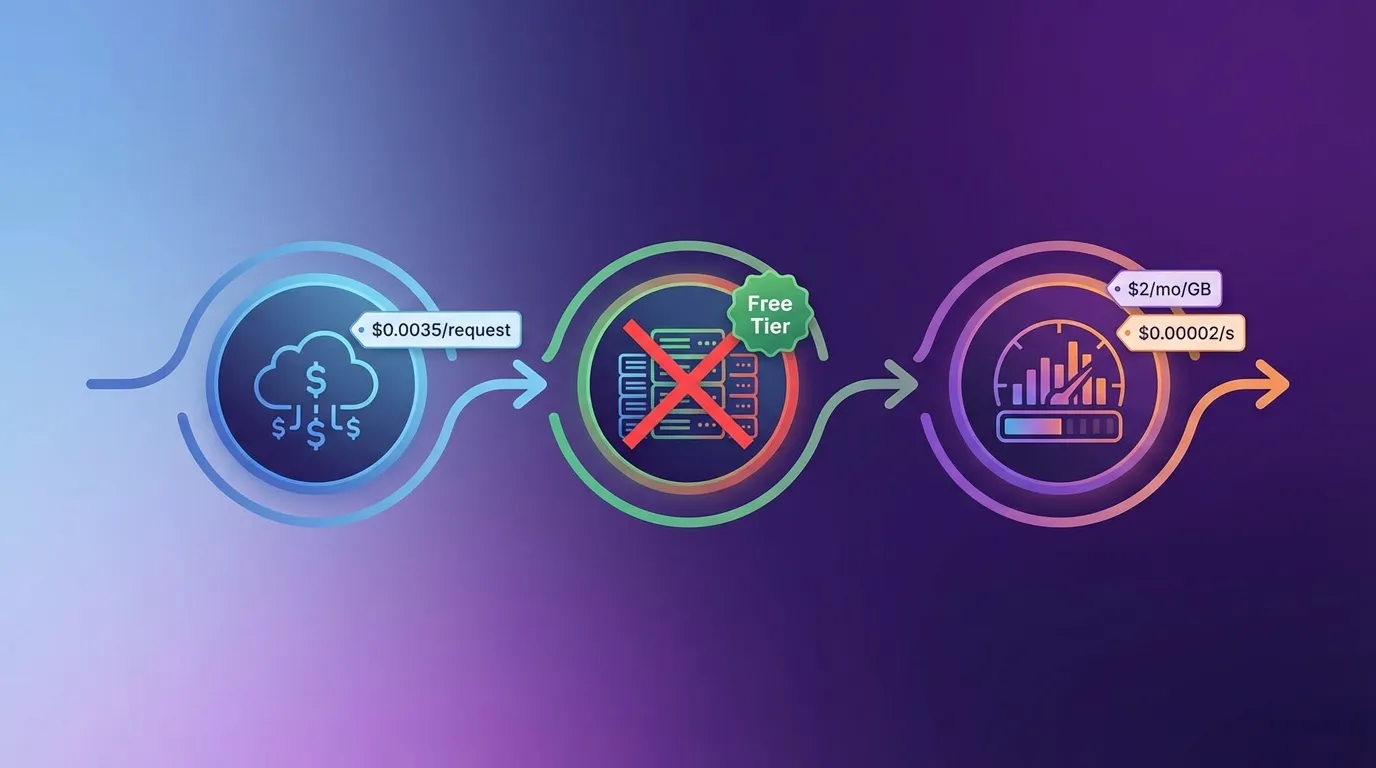
Fly.io Free Tier: Did They Remove It? Pricing History 2026
Fly.io killed free allowances for new users. Now just a 2-hour trial. Full pricing timeline from $0.0035/request (2017) to pay-as-you-go + $29 support tier.
Fly.io Free Tier: Did They Remove It? Complete Pricing History (2017-2026)
Prices verified: March 6, 2026 | Source: fly.io/pricing | Data: Archive.org snapshots + our daily monitoring
Yes, Fly.io removed free allowances. New users now get a 2-hour free trial (or 7 days, whichever ends first). Legacy customers on deprecated plans keep their old free resources, but everyone else pays from day one.
I've tracked Fly.io's pricing since 2017 using Archive.org snapshots and daily monitoring. What I found is a complete identity shift. They went from a CDN charging $0.0035 per request to a full app hosting platform with VM-based billing. Here's the timeline, backed by 22 snapshots across 9 years.
How Did Fly.io Pricing Change Over Time?
| Period | Model | Free Tier | Starting Price |
|---|---|---|---|
| 2017-2018 | Per-request CDN | Yes (included) | $0.0035/request |
| 2019-2023 | VM + free allowances | 3 VMs + 160GB transfer | Pay-as-you-go |
| 2024 | Pay-as-you-go + support tiers | Legacy only | $29/mo support |
| 2025-2026 | Pay-as-you-go + 2h trial | 2 hours or 7 days | Usage-based |
That's three distinct pricing identities in under a decade. Each shift reflected where Fly.io was heading as a company — from CDN upstart to Heroku challenger to pure infrastructure play. Let me walk through what actually happened at each stage.
Phase 1: The CDN Era — Per-Request Pricing (2017-2018)
Our earliest Archive.org snapshot is from May 2017. Back then, Fly.io wasn't an app hosting platform at all. It was closer to a CDN: you paid per HTTP request, priced by geographic region.
| Region | Per Request | Bandwidth/GB |
|---|---|---|
| North America | $0.0035 | $0.18 |
| Europe | $0.0045 | $0.18 |
| Asia Pacific | $0.0045 | $0.21 |
| South America | $0.0055 | $0.25 |
| Africa | $0.0055 | $0.25 |
A free tier was included by default. The pricing model was simple: you paid for what your app served. Our February 2018 snapshot shows identical pricing. This suggests the model was stable for at least a year. The free tier had no stated limits in these early snapshots — just "free for the first 2 million requests and 100GB of data per month."
For context, this was before Docker-on-the-edge became mainstream. Fly.io was competing with Cloudflare Workers and Fastly, not Heroku or Railway. The per-request model made sense for a CDN product. It would not survive the platform pivot.
Phase 2: The Platform Pivot — VMs and Free Allowances (2019-2023)
Between 2018 and 2024, Fly.io changed completely. It went from a CDN to a full app hosting platform. Our archive data has a gap here (no snapshots from 2019-2023), but the shift is well-documented elsewhere.
In 2020, Fly.io launched managed Postgres and started positioning as a Heroku alternative. That same year, the company raised $40M across Series A and B to build out their edge compute vision. By late 2024, they had reinvented themselves around Firecracker-based micro VMs.
During this era, Fly.io introduced:
- Micro VMs on Firecracker (the same tech behind AWS Lambda)
- Free allowances: 3 shared-cpu-1x VMs, 256MB RAM, 3GB storage, 100-160GB bandwidth
- Named plans: Hobby, Launch, and Scale tiers
- flyctl CLI for deploys (no Git push — a deliberate choice)
This was the golden era for Fly.io's free tier. Developers ran small apps for free, with no time limit. The community grew fast. Hacker News threads praised the platform as "the best Heroku replacement." The free allowances were generous enough for side projects, demos, and low-traffic production apps.
Phase 3: Plans Deprecated, Free Tier Killed (2024)
Our October 2024 Archive.org snapshot marks the turning point. The pricing page no longer shows a free tier. Instead, we see:
- Pay-as-You-Go Infrastructure — usage-based, no monthly plan
- Serious Support — $29/month (dedicated engineering team)
- Compliance Made Easy — $99/month (HIPAA workloads)
- Enterprise-Ready — contact sales
Fly.io deprecated the Hobby, Launch, and Scale plans entirely. Existing customers on those plans kept their free allowances as a legacy benefit. But new signups got nothing free — just pay-as-you-go from the start.
Our monitoring shows this pricing structure remained stable from October 2024 through March 2026 — 17 consecutive monthly snapshots with the same $29/$99 tiers. No price increases on the support add-ons.
What Does Fly.io's Free Trial Actually Include Now?
As of 2026, new Fly.io accounts get a free trial, not a free tier. The difference matters:
| Resource | Free Trial Limit |
|---|---|
| Duration | 2 VM hours OR 7 days (whichever first) |
| Machines | 10 maximum |
| Storage | 20GB volume |
| CPU per machine | Up to 2 vCPUs |
| RAM per machine | Up to 4GB |
| GPUs | Not available |
| Dedicated IPv4 | Not available |
Two VM hours is barely enough to deploy and test a basic app. Machines auto-shutdown after 5 minutes of inactivity to conserve trial time. When you hit the limit, your apps stop and you can't deploy until you add a credit card.
Compare that to the old free allowances (3 always-on VMs, 160GB bandwidth, no time limit) and you can see why the community reaction was mixed.
How Does Fly.io Compare to Railway and Render Now?
With Fly.io's free tier effectively gone, the competitive landscape for developer hosting looks different:
| Platform | Free Tier | Starting Paid | Best For |
|---|---|---|---|
| Fly.io | 2h trial only | Pay-as-you-go (~$5+) | Multi-region/edge apps |
| Railway | $5 credit/month | $5/mo Hobby | Fastest DX, built-in DB |
| Render | Free tier (750h) | $7/mo Starter | Predictable monthly billing |
| Vercel | Hobby (free) | $20/mo Pro | Frontend/Next.js |
If you specifically need edge/multi-region deployment, Fly.io is still the strongest option. But if you want to experiment for free, Railway's $5 monthly credit or Render's 750-hour free tier are more practical starting points.
Why Did Fly.io Remove the Free Tier?
Fly.io never published an official explanation, but the community discussions point to a few factors:
- Abuse at scale. Free compute attracts crypto miners and spam bots. Policing free usage costs more than the goodwill it creates.
- Platform maturity. Fly.io moved upmarket with HIPAA and enterprise features. Free hobbyist compute no longer fit the strategy.
- Sustainability. Always-on VMs cost real money. That's hard to give away free when your pitch is "run close to users globally."
This mirrors a broader trend in developer tools. Heroku removed its free tier in November 2022 after years of abuse. The era of unlimited free compute is ending across the industry.
Our Data: 22 Snapshots, 9 Years of Tracking
Data source: 22 pricing page snapshots we've collected for Fly.io over 9 years. This is one of the most complete pricing histories we've built for any hosting platform.
- 2 Archive.org snapshots from the CDN era (May 2017, February 2018)
- 14 Archive.org snapshots from the platform era (October 2024 through November 2025)
- 6 realtime snapshots from our daily monitoring (November 2025 through February 2026)
We track Fly.io's pricing page daily. If they change anything — plans, prices, free trial terms — we'll detect it automatically and update this page. See our Notion pricing history for another example of what 18 years of data reveals.
Share this article
Start Tracking SaaS Pricing Today
Never miss a competitor pricing change. Get instant alerts and stay ahead.
Start Tracking Free →