
State of SaaS Pricing Q2 2026: Only 6 Real Price Changes
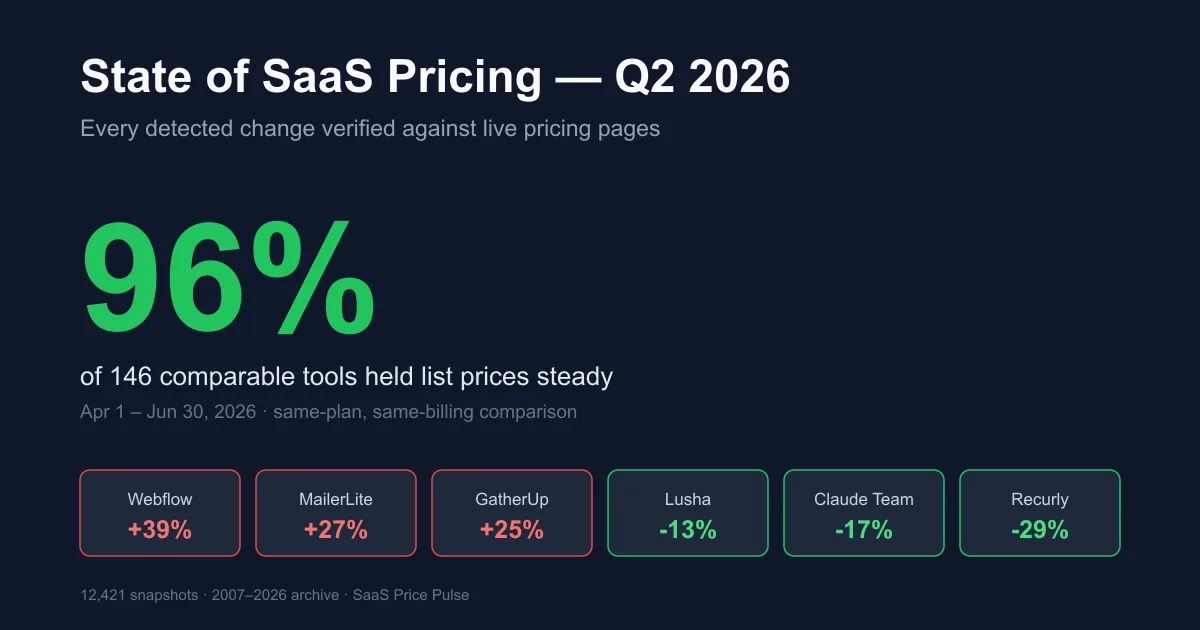
We verified every Q2 2026 price change against live vendor pages: 6 real moves across 146 SaaS tools. Webflow +39%, MailerLite +27%, Claude Team -17%.
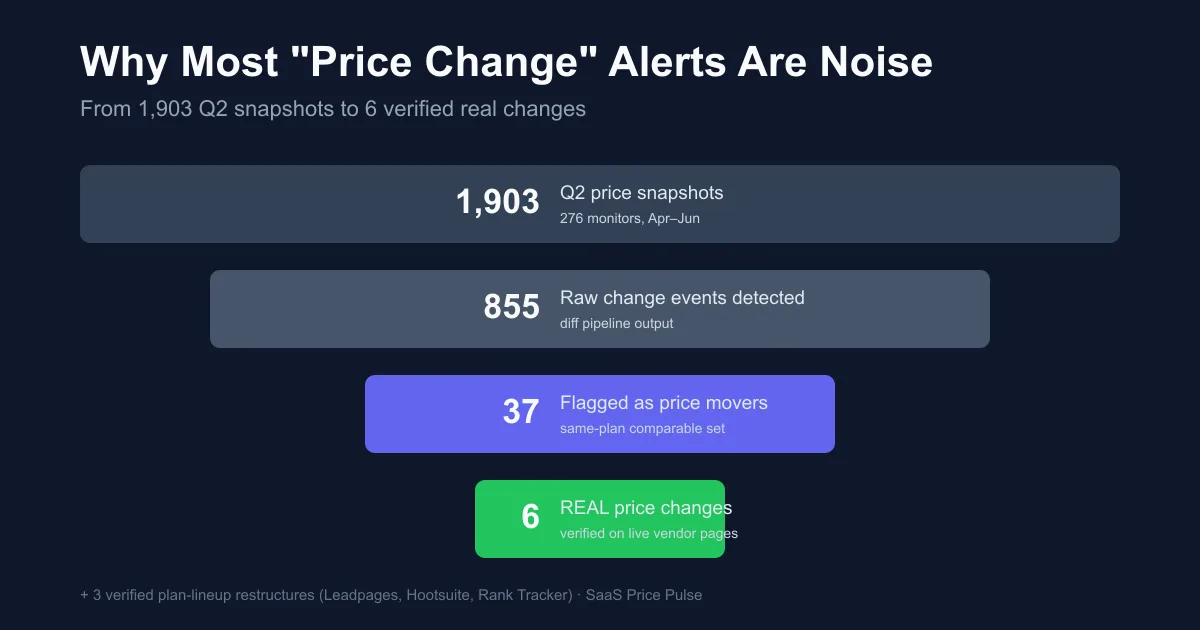
Our pipeline logged 855 pricing-page change events across 276 SaaS tools in Q2 2026. Then we did something most trackers never do. We checked every flagged price change against the vendor's live pricing page before publishing it. The result is uncomfortable for the "SaaS inflation" narrative — and for automated trackers, including ours. Only 6 tools genuinely changed list prices. The rest of the movement was packaging: renames, tier mergers, billing splits, and retired plans.
Quick Answer
96% of SaaS tools held list prices steady in Q2 2026 (140 of 146 tools with comparable plans). Verified increases: Webflow Basic +39% (billed monthly), MailerLite +10–30%, GatherUp +25% (monthly billing). Verified decreases: Recurly RevRec -29%, Claude Team -17%, Lusha Pro -13%. Another three vendors — Leadpages, Hootsuite, and Rank Tracker — restructured their plan lineups instead of changing prices. Most price movement in Q2 2026 came from packaging changes, not sticker changes. Last verified: July 2, 2026.
Source: SaaS Price Pulse — same-plan, same-billing comparison across 12,421 snapshots, with every named mover checked against the live vendor page.
Key Findings
The four numbers that define the quarter — each backed by a live check of the vendor's pricing page, not just an automated diff. Full verification methodology in section 1; the failure modes we filtered out are dissected in section 6.
1. How Did We Verify Every Price Change?
SaaS Price Pulse monitors 276 pricing pages with automated crawls. Behind that sits an archive of 12,421 snapshots going back to 2007 — 7,732 from Archive.org and 4,689 from live crawls. For this report we compared each tool's pricing at the start and end of Q2 2026 (April 1 to June 30). Raw diffs are not enough, though. Pricing pages are full of traps: promo banners, billing toggles, geo-localized currencies. So this quarter we added a second layer that most pricing datasets skip entirely. Every flagged change was verified by hand against the live vendor page.
Which tools qualify for the comparison?
Comparison Rules
- Verified baseline only: 232 of 276 monitors passed 3-source baseline verification. The other 44 were excluded.
- Same plan, same billing period: we only compare a plan against itself — Pro billed monthly against Pro billed monthly. Never annual against monthly.
- Restructures counted separately: 28 tools changed lineups so much that no plan name survived the quarter. They are reported as restructures, not price changes.
- Usage-based tools excluded: 7 tools priced per-transaction (Stripe, Twilio, Amazon SES and similar) have no plan price to compare.
- Result: 146 tools comparable like-for-like across the quarter.
These rules matter more than they look. Our first analysis pass compared the "cheapest paid plan" without matching plan names. It produced a headline claiming 43% of tools cut prices. That number was garbage. It compared Stripe's $500 Atlas fee against a $0.03 transaction rate. Same-plan matching killed most of that noise before verification even started.
What does the verification layer catch?
The comparison flagged 37 tools as price movers. We did not publish that list. Instead, we checked every single one against three sources: the vendor's live pricing page, Wayback Machine snapshots from both ends of the quarter, and at least one independent pricing guide. That's 34 separate verification checks. Only 6 movers survived. The other 31 were promo banners, billing-toggle flips, wrong plans, or currency leaks. Section 6 dissects them one by one. If you consume any automated pricing feed, those failure modes are in your data too.
2. What Actually Changed in Q2 2026?
The short answer: very little — and what did change mostly happened in packaging, not price cards. Here are the five findings that survived verification:
- Q2 2026 was one of the quietest pricing quarters we've measured. 140 of 146 comparable tools (96%) kept list prices exactly where they were on April 1.
- The real movement was packaging. Nine verified pricing events this quarter. Six involved restructuring — renamed plans, merged tiers, new billing splits, retired entry plans — rather than a simple sticker change.
- AI price compression continued. The biggest seat-price cut came from Anthropic: Claude Team dropped from $30 to $25 per seat. Cursor Pro, Perplexity Pro, and ChatGPT Plus all held steady. We verified each one after our pipeline flagged false movers on all three.
- Increases hid behind renames and billing toggles. MailerLite raised prices 10–30% on June 16 while renaming its mid-tier plan. GatherUp kept its $60 annual price and quietly added a $75 monthly-billing tier.
- 84% of automated "price change" flags were artifacts. If your pricing data comes from an unverified feed — or from an AI assistant citing one — most of the dramatic changes in it are probably noise.
3. Which SaaS Tools Raised Prices?
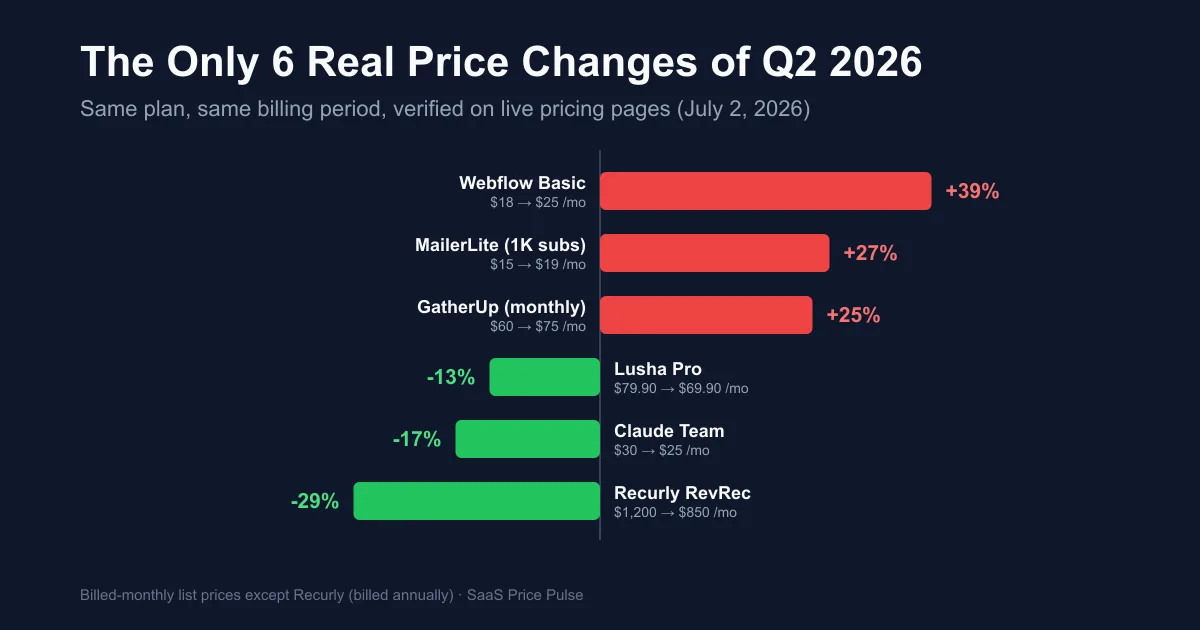
Three increases survived live verification. Each one tells you something about how price increases actually happen in 2026: loudly with a plan overhaul (Webflow), silently behind a rename (MailerLite), or structurally through billing options (GatherUp). Between them they cover the full spectrum — from a change every customer heard about to one that almost nobody noticed.
| Tool | Plan | Before | After | Change | When |
|---|---|---|---|---|---|
| Webflow | Basic (billed monthly) | $18/mo | $25/mo | +39% | May 13 (new), Jun 29 (renewals) |
| MailerLite | Growing Business → "Comfort" (1K subs, monthly) | $15/mo | $19/mo | +27% | June 16, 2026 |
| GatherUp | Single Location (billed monthly) | $60/mo | $75/mo | +25% | April–May 2026 |
Why did Webflow prices jump up to 39%?
Webflow's May 2026 "simplified plans" overhaul was the only broadly announced repricing this quarter. Basic rose from $14 to $15 per month billed annually (+7%) and from $18 to $25 billed monthly (+39%). Read those two numbers together: the increase is mild if you prepay for a year, and steep if you pay month to month. The overhaul also merged the CMS and Business site plans into a single "Premium" plan at $25 per month billed annually. New purchases got the new prices from May 13. Existing subscriptions renewed into them from June 29. That means many customers will only feel this change on their July invoice.
How did MailerLite hide a 27% increase?
On June 16, MailerLite renamed its mid-tier "Growing Business" plan to "Comfort" and moved prices up 10–30% depending on subscriber count: $10 to $12 per month at 500 subscribers, $15 to $19 at 1,000 (billed monthly). Rename-plus-reprice is a classic play. The new name breaks direct price comparisons in most tracking tools. It broke ours too: our pipeline initially misread this event as a price decrease from a different slider position. Only the manual verification pass caught what actually happened. If you rely on invoice line items, compare what you pay — not what the plan is called.
What is GatherUp's billing-split increase?
GatherUp's single-location price was a flat $60 per month with no billing options. During Q2 the pricing page gained a monthly/annual toggle. The $60 price survived — but only for annual prepay. Month-to-month now costs $75, a 25% premium that never existed before. Every plan moved the same way; Small Business went from $99 flat to $124 monthly or $99 annual. No announcement, no price-increase headline, and if you track only the default toggle (annual), the page looks unchanged. Monthly-billing customers got a real increase.
4. Which SaaS Tools Cut Prices?
Three decreases survived verification — and each one carries a caveat that a headline percentage can't. One is genuine competitive repricing (Recurly), one is the AI price war reaching team plans (Claude), and one looks like a discount but may cost heavy users more (Lusha).
| Tool | Plan | Before | After | Change | Context |
|---|---|---|---|---|---|
| Recurly | RevRec (billed annually) | $1,200/mo | $850/mo | -29% | Entry price cut between Apr 17 and Jun 20 |
| Claude Team (Anthropic) | Standard seat | $30/seat/mo | $25/seat/mo | -17% | Annual seat $25 → $20 (-20%); Premium seat $150 → $125 |
| Lusha | Pro (billed monthly) | $79.90/mo | $69.90/mo | -13% | April repricing — see the credit-model caveat below |
Is Claude getting cheaper for teams?
Yes. Anthropic cut Claude Team's Standard seat from $30 to $25 per seat billed monthly, and from $25 to $20 billed annually. The Premium seat fell from $150 to $125. In our Q1 report we noted that none of the AI tools in our dataset were raising prices. Q2 delivered the first outright cut on a major AI team plan. Meanwhile the consumer AI anchor hasn't moved: Cursor Pro, Perplexity Pro, and ChatGPT Plus all still cost $20 per month, exactly where they've been for two years. When compute costs fall, competition passes it through — teams shopping for AI seats have real leverage right now.
Is Lusha's price cut really a cut?
On the sticker, yes: Pro fell from $79.90 to $69.90 per month, billed monthly (-13%). Underneath, Lusha's April restructure also switched from per-seat pricing to flat two-seat credit bundles and changed how phone-reveal credits are counted. Depending on your usage mix, the effective cost per contact can end up higher than before the "cut". This is the sharpest example in the whole quarter of why headline percentages need context — a price decrease and a cost increase can be the same event.
Why did Recurly drop RevRec 29%?
Recurly's revenue-recognition add-on advertised "pricing starts at $1,200" in mid-April. By June 20 the page said $850 per month, billed annually — a 29% cut to the entry price, with no announcement we could find. Billing and RevRec tooling is a crowded market. Entry-price cuts without press releases usually mean the sales team needed a lower door to compete for mid-market deals. Whatever the motive, this was the largest verified decrease of the quarter. One tracking note: our pipeline initially recorded this change as "$100 to $70.83" — a normalization bug had divided the real per-month prices by twelve. The direction and magnitude were right; the absolute numbers only became correct after checking the live page.
5. How Do Vendors Move Prices Without Touching the Sticker?
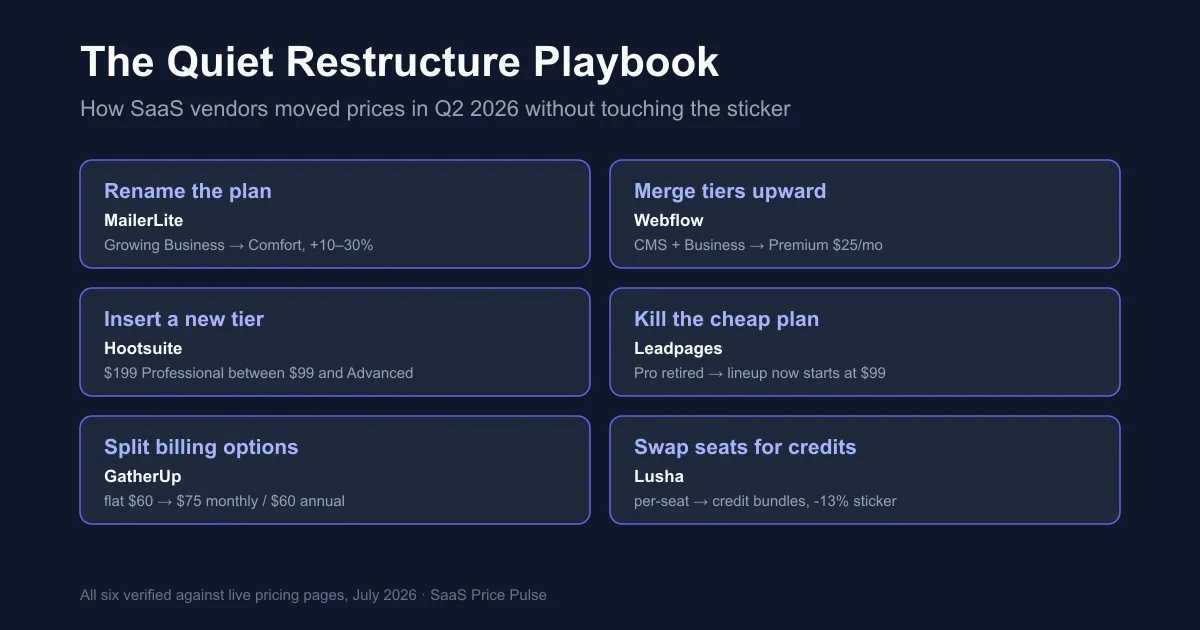
Add the verified restructures to the six price moves and the quarter's real pattern appears. Vendors overwhelmingly preferred to change packaging rather than the number on the price card. Renames and mergers break price-comparison content. They avoid "price increase" headlines. They also reset customer anchoring. If you only watch sticker prices, you'll conclude SaaS pricing is frozen. If you watch packaging, Q2 was busy.
| The Play | Who Ran It | What Happened |
|---|---|---|
| Rename the plan | MailerLite | Growing Business became "Comfort" with prices up 10–30% |
| Merge tiers upward | Webflow | CMS + Business merged into Premium at $25/mo annual |
| Insert a new tier | Hootsuite | New $199 Professional tier landed between Standard ($99) and enterprise plans |
| Kill the cheap plan | Leadpages | Pro ($99/mo, $74 annual) retired; lineup now starts at Grow $99, then $199 and $399 |
| Split billing options | GatherUp | Flat $60 became $75 monthly / $60 annual — a hidden monthly surcharge |
| Swap seats for credits | Lusha | Per-seat pricing became credit bundles; sticker down 13%, unit costs up for some |
One more restructure deserves a mention: Rank Tracker replaced its entire lineup — the old Starter/Double/Quad/Hex Data plans ($24–$209) became Launch $39, Growth $89, Scale $149, and Authority $299 sometime between February and June. The entry price rose 63% without any single plan "changing price". Expect more of this play; it is the cheapest way to raise prices without generating a headline.
6. Why Were 84% of Detected "Changes" Fake?
What fools automated price trackers?
Of the 37 movers our comparable-set analysis flagged, 31 did not survive live verification. This is the section most pricing trackers won't write, and it's the one we most want you to read. Here is what those "price changes" actually were:
| Failure Mode | Examples | What Happened |
|---|---|---|
| Annual vs monthly toggle | Browse AI "+153%", Hunter.io "+44%", Synthesia "-34%", Hotjar "-20%" | The crawler captured the annual-billed price one month and the monthly-billed price the next. Both prices were live all along. |
| Promo captured as list price | Slack "-40%", FreshBooks "-67%", HubSpot "-86%" | Slack's $4.38 is a 50%-off-for-3-months banner. FreshBooks' $2.30 is "90% off for 6 months". HubSpot's $7 is a new-customer promo. List prices unchanged. |
| Wrong plan or product | Cursor "+100%", Monday.com "+158%", Discord "-40%" | Cursor's $40 is the Teams seat, not Pro. Monday's $31 is "monday service", a different product. Discord's $4.99 was the retired Nitro Classic. |
| Geo-currency leak | Zoho CRM "-98%" | The pricing page served Indian rupees. ₹1,400 was stored as $1,400. Zoho's USD prices never moved. |
| Normalization bugs | Agorapulse "-92%", Frase "-20%" | Already-monthly prices divided by 12 a second time. Agorapulse Standard is $79/mo on annual billing, not $6.58. |
| Stale baselines | Procreate "+20%", Hootsuite "+421%" | Procreate Pocket has cost $5.99 since mid-2024 — our $4.99 baseline was old. Hootsuite's $19 baseline was a mis-extraction; Standard was $99 all along. |
Why publish our own failures?
Two reasons. First, transparency. These artifacts exist in every automated pricing tracker. Pretending otherwise produces reports whose headline numbers are simply wrong. We would rather show the funnel than fake the certainty. Second, as a consumer warning. Pricing data now flows into AI assistants, procurement tools, and budget spreadsheets without anyone looking at the vendor's page. If a dataset or an AI answer quotes a dramatic SaaS price change, ask whether a human verified it. In our own pipeline, five of every six flags failed that test this quarter. The fixes we made along the way — rename detection, promo filtering, stricter currency guards — go straight back into our public change feed.
7. How Reliable Is This Data?
What's In, What's Out
- In: 146 tools with a verified baseline and the same plan name plus billing period observable at both ends of Q2 — last observation before April 1 versus latest in June.
- Out — pending verification: 44 monitors whose baselines haven't passed 3-source verification yet.
- Out — usage-based: 7 tools priced per-unit, with no plan price to compare.
- Out — restructured: 28 tools where no plan name survived the quarter. Three were verified as deliberate lineup overhauls (section 5); the rest reflect extraction-schema changes on our side.
- Excluded snapshots: a corrupt crawl batch from June 22 — a crawler migration briefly produced wrong-region prices — was excluded from both sides of every comparison.
- Verification: all 37 flagged movers were checked against live vendor pages on July 1–2, 2026. Only verified changes are named in this report.
What are the known limitations?
- List prices only. Negotiated, enterprise, and volume discounts are invisible to us.
- Q1 comparison caveat. Our Q1 2026 report measured lifetime drift — earliest versus latest snapshot, 2007 to 2026. This report measures a single quarter with a live-verification layer. The two headline percentages are not directly comparable, and we make no "acceleration" claims.
- Promo-heavy vendors are hard to track. Tools that permanently display discount pricing blur the line between list price and street price.
- Slider pricing. Volume-based tools have a different price at every slider position. We compare at the captured position and say so when it matters.
- One-time purchases excluded. Tools sold as a single purchase rather than a subscription don't appear in monthly-price statistics.
8. What Should You Watch in Q3 2026?
Four storylines from this quarter's data are still in motion. Each has a concrete signal worth watching:
| Watch Item | Why It Matters |
|---|---|
| Webflow renewals in July | Existing customers only started paying new prices on June 29. Pushback — and any grandfathering concessions — plays out in Q3. |
| The widening monthly-billing penalty | Webflow (+39% monthly vs +7% annual) and GatherUp (+25% monthly vs 0% annual) both steered buyers toward annual prepay. Watch for more vendors repricing only the monthly toggle. |
| An AI team-plan price war | Claude Team's cut to $25/seat undercuts several team AI offerings. If OpenAI or Google respond on team pricing, Q3 could see the first sustained B2B AI price war. |
| Rename-and-reprice spreading | MailerLite's June move suppressed most tracking comparisons. We're adding rename-detection to our pipeline for Q3 to keep catching this play. |
9. What Does This Mean for Your Budget?
The practical takeaways are different from what a "SaaS prices are exploding" headline would suggest. List prices are mostly flat. The real budget risk sits in packaging: a renamed plan on your invoice, a merged tier at renewal, a billing toggle that quietly costs 25% more month-to-month. Those changes don't show up in inflation narratives. Most of them never get announced. The defense is simple. Know what you pay per seat and per billing period. Compare that number, not the plan name, at every renewal.
Which five moves should you make this month?
- 1. Don't panic about SaaS inflation. 96% of tools held list prices.
- 2. Audit your billing period. This quarter's stealth increases hit monthly billing hardest.
- 3. Re-quote your AI tools. Claude Team dropped 17–20%.
- 4. Watch for plan renames on invoices. A renamed plan is the most common disguise for a price change.
- 5. Verify before you cite. 84% of automated flags were artifacts — check the vendor's page.
Track SaaS Pricing Changes Automatically
Get notified when the tools you pay for change pricing — with the verification layer built in, so you act on real changes instead of promo banners and billing-toggle noise. We monitor 276 SaaS tools on top of 12,000+ historical snapshots covering 19 years of pricing history. Add the tools in your stack, set your alert threshold, and get a clean signal each time a list price genuinely moves. Free to start, no credit card required.
Start Tracking Free →About This Report
SaaS Price Pulse tracks 276 SaaS pricing pages with automated monitoring and AI-powered extraction, on top of an Archive.org-backfilled dataset reaching back to 2007. For this report, every flagged price change was individually verified against the vendor's live pricing page before publication.
Methodology: 12,421 snapshots · 232 verified-baseline monitors · 146 tools compared same-plan/same-billing across Q2 2026 · 34 live verification checks · published July 2, 2026. Report updated quarterly.
Published July 2, 2026. See the Q1 2026 report, browse the live change feed, or subscribe via RSS.
Share this article
Start Tracking SaaS Pricing Today
Never miss a competitor pricing change. Get instant alerts and stay ahead.
Start Tracking Free →