
Mailgun Pricing 2026: Plans & Reviews
Developer email service
🔔 Get alerted the next time Mailgun changes its price
Instant email + Slack alerts on real price changes. From $19/month.
Quick Verdict
Bottom Line
Mailgun is a developer-first transactional email service with solid API quality and reliable deliverability. At $35/month for 50,000 emails, it's mid-range compared to SendGrid ($19.95/mo for 50K) and Postmark ($15/mo for 10K). The free tier is limited to 100 emails/day, making it more of a sandbox than a real free plan.
Who Should Use It
- Developers building apps that need transactional email (password resets, notifications, receipts)
- SaaS companies sending 10K-100K emails/month with API-first workflows
- Teams needing SMTP relay with detailed delivery tracking and webhooks
- Organizations requiring email validation alongside sending
Who Should Skip It
- Marketing teams needing drag-and-drop campaign builders (consider Mailchimp or Brevo)
- Startups needing generous free tier (consider Resend at 100 emails/day free, or Amazon SES pay-as-you-go)
- Small businesses with under 5,000 emails/month (SendGrid free tier gives 100/day)
- Teams wanting CRM + email in one platform (consider HubSpot or GetResponse)
What is Mailgun?
Mailgun has been a go-to transactional email API since 2011, now owned by Sinch (acquired in 2021). It powers email infrastructure for companies like GitHub, Slack, and Lyft.
We've tracked Mailgun's pricing across 139 snapshots since 2018 and it's been remarkably stable compared to competitors like SendGrid who raised prices ~10% in 2024. That pricing consistency matters when you're budgeting infrastructure costs for a growing SaaS.
Unlike marketing platforms like Mailchimp, Mailgun focuses purely on programmatic email delivery. You send emails via REST API or SMTP relay, and Mailgun handles deliverability, bounce processing, and analytics. No drag-and-drop editors, no campaign management.
The pricing is straightforward: 5 tiers from Free to Enterprise, with overage charges per 1,000 emails. Foundation ($35/mo) includes 50,000 emails and is where most small-to-mid SaaS companies land. Scale ($90/mo) adds dedicated IPs and live support for teams sending 100K+ emails monthly.
*Pricing data sourced from [Mailgun official pricing page](https://www.mailgun.com/pricing/). Last verified February 23, 2026. We monitor this page automatically and update when changes are detected.*
Key Features That Affect Pricing
| Feature | Free | Pro | Business |
|---|---|---|---|
| Monthly Emails | 100/day (~3K/mo) | 50,000 | 100,000 |
| Custom Domains | 1 | 1,000 | 1,000 |
| Log Retention | 1 day | 5 days | 30 days |
| Email Validation | Included | 5,000 free | |
| Dedicated IP | Pools available | ||
| Template Builder | Yes | Yes | |
| Support Level | Ticket only | Phone & chat |
What Makes Mailgun Different
- 1Rock-solid API with 99.99% uptime SLA – REST and SMTP APIs with comprehensive SDKs (Python, Ruby, PHP, Node.js, Go, Java). Webhooks for every delivery event. Used by GitHub and Slack for mission-critical email.
- 2Built-in email validation API – Verify email addresses before sending to reduce bounces. Included on Foundation+ plans. Standalone validation would cost $20-50/mo with other providers like ZeroBounce.
- 3Detailed analytics and log retention – Track opens, clicks, bounces, complaints at individual email level. Scale plan retains logs for 30 days. Webhooks for real-time delivery event streaming.
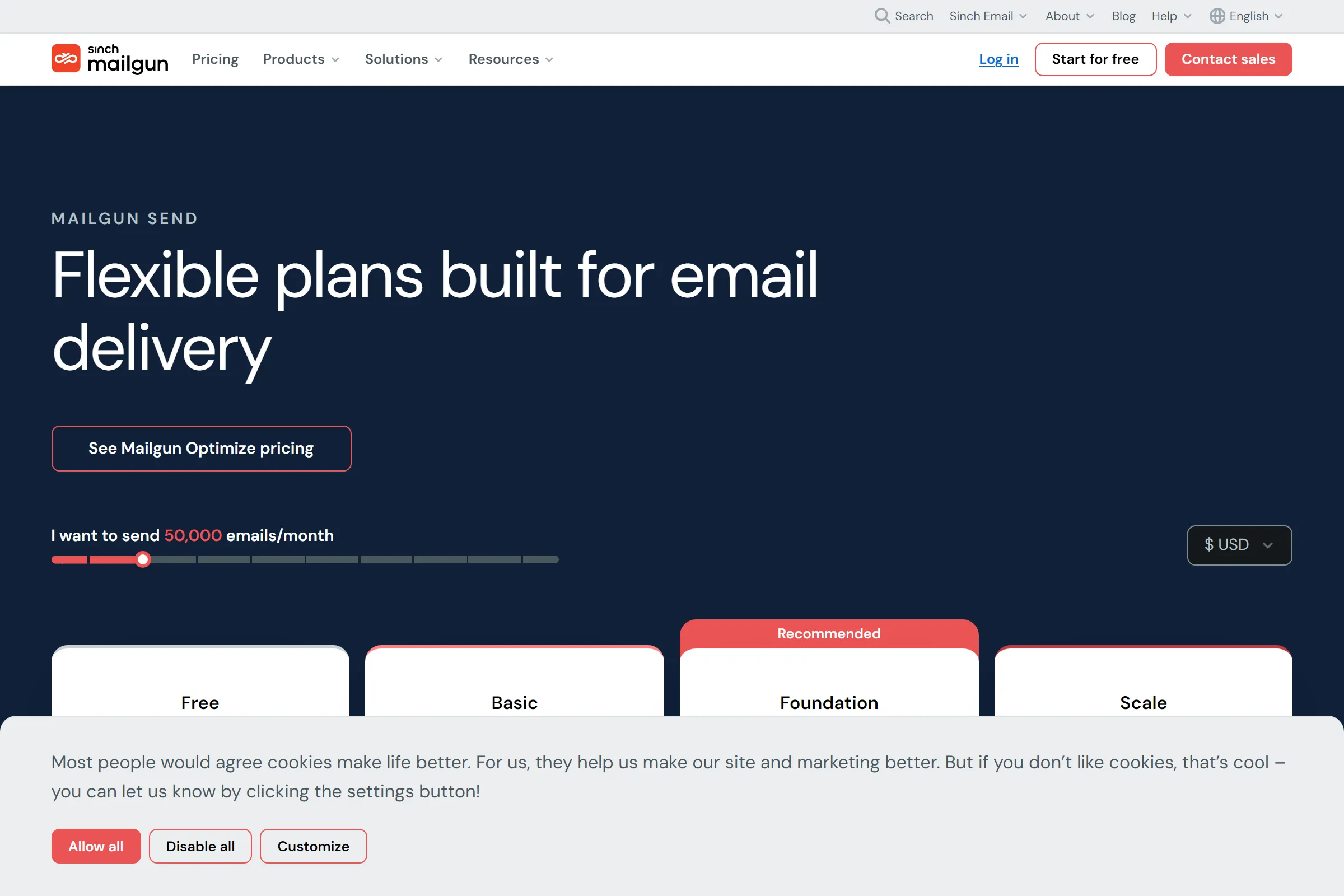
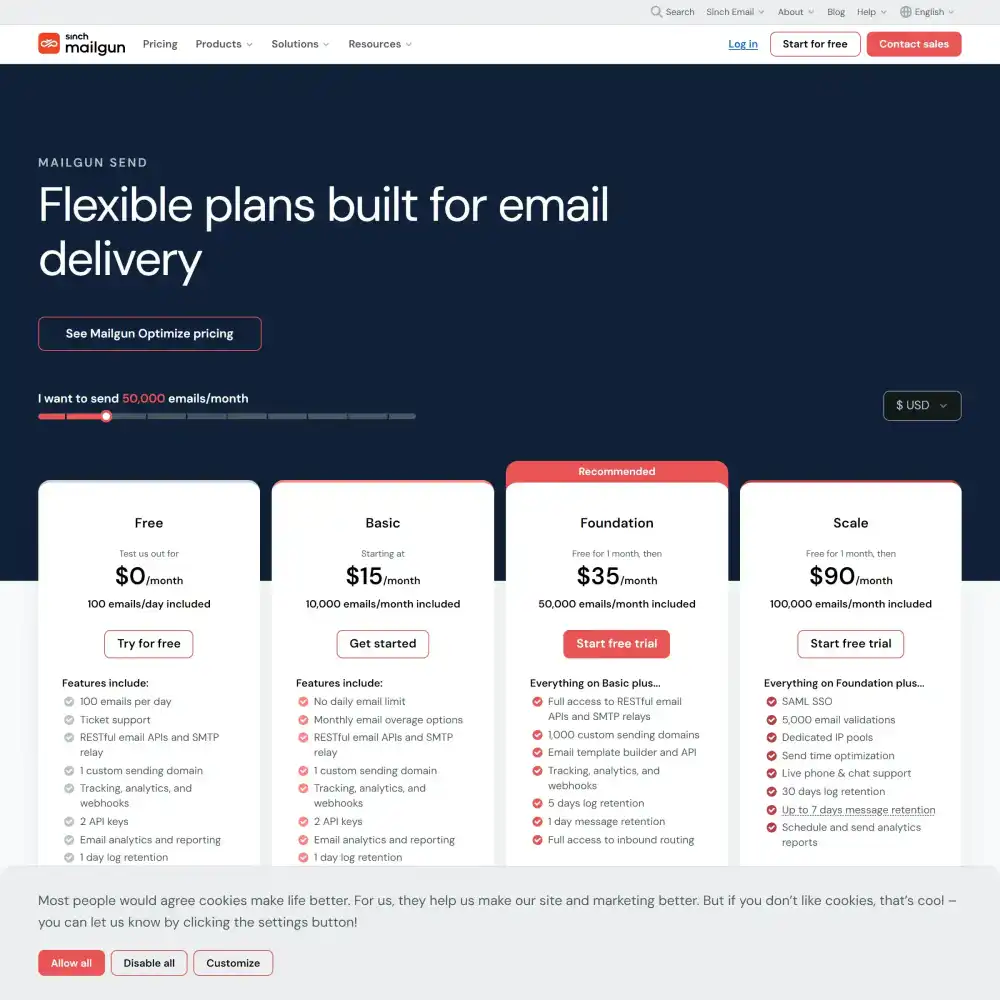
Mailgun Pricing Plans 2025
Free
Best for: Development and testing only
- 100 emails per day (~3,000/month)
- REST API and SMTP relay
- 1 custom sending domain
- Tracking, analytics, webhooks
- 2 API keys
- 1 inbound route
Value Analysis: Only useful for development sandboxes. 100 emails/day is too restrictive for any production use. SendGrid gives 100/day free too, while Amazon SES charges $0.10/1,000 with no monthly fee.
Basic
Best for: Small apps with low email volume
- 10,000 emails/month
- No daily sending limit
- SMTP relay + REST API
- 1 custom domain
- 5 inbound routes
- 1 day log retention
Value Analysis: Decent entry point at $15/mo for 10K emails. Overage is $1.80/1,000 emails. Compare: SendGrid Essentials starts at $19.95/mo for 50K emails with better value per email.
Foundation
Best for: Growing SaaS sending 10K-50K transactional emails
- 50,000 emails/month
- Email template builder and API
- 1,000 custom sending domains
- Email validation included
- 5 days log retention
- 1 day message retention
- Full inbound routing
Value Analysis: The sweet spot for most SaaS companies. $35/mo for 50K emails + validation is competitive. Overage at $1.30/1K. Postmark charges $50/mo for 50K emails, so Mailgun is 30% cheaper here.
Scale
Best for: Teams sending 50K-100K+ emails needing premium support
- 100,000 emails/month
- Everything in Foundation
- SAML SSO
- 5,000 email validations
- Dedicated IP pools
- Send time optimization
- Live phone and chat support
- 30 days log retention
- 7 days message retention
Value Analysis: Worth upgrading for dedicated IPs and phone support. 30-day log retention is a big jump from Foundation's 5 days. At $0.90/1K emails, competitive with Amazon SES at high volumes.
Enterprise
Best for: High-volume senders (500K+ emails/month)
- Custom email volume
- Dedicated account manager
- Custom SLA
- Priority support 24/7
- Custom integration support
Hidden Costs to Watch Out For
- 1. Email overage charges: Basic: $1.80/1K, Foundation: $1.30/1K, Scale: $1.10/1K. These add up fast if you exceed your plan limit regularly. Monitor usage closely.
- 2. Email validation costs: Foundation: $1.20/100 validations beyond included amount. Scale: $0.80/100. Budget separately if validating large lists.
- 3. Dedicated IP warmup: Scale plan includes dedicated IP pools, but new IPs need 2-4 weeks of gradual warmup to build sender reputation. Not plug-and-play.
- 4. No annual discount publicly listed: Unlike competitors like SendGrid (30% annual discount), Mailgun doesn't prominently advertise yearly billing savings. Contact sales for potential discounts.
Pro tip: From what we've seen monitoring hundreds of email API tools, Foundation ($35/mo) is the best value for most developers. The jump from Basic ($15) to Foundation gets you 5x more emails, email validation, template builder, and 5-day log retention. Only upgrade to Scale ($90) when you need dedicated IPs or phone support.
Pros & Cons
Pros
- Developer-friendly API – Clean REST API with SDKs for every major language. Comprehensive webhook system for delivery events. Well-documented with Postman collections.
- Email validation built-in – Verify email addresses before sending. Reduces bounces, protects sender reputation. Would cost $20-50/month as a separate service.
- Reliable deliverability – Mailgun handles SPF, DKIM, DMARC configuration. Shared IP pools are well-maintained. Dedicated IPs available on Scale plan.
Cons
- Free tier is basically a sandbox – 100 emails/day is too restrictive for production. Competitors like SendGrid and Resend offer more generous free tiers for startups.
- No marketing email features – Pure transactional focus. No campaign builder, no A/B testing for marketing emails, no drag-and-drop editor. Need a separate tool for newsletters.
- Per-email pricing gets expensive at scale – At 500K emails/month, Mailgun costs significantly more than Amazon SES ($0.10/1K). Volume senders should compare carefully.
Our Take
In our experience tracking 260+ SaaS tools, Mailgun stands out for pricing stability - we haven't detected a single price increase across 139 snapshots since 2018. That's rare in a market where 46% of SaaS tools raised prices in the past year. The Foundation plan at $35/month hits a sweet spot for SaaS companies sending under 50K transactional emails. For pure volume, Amazon SES is cheaper. For the newest developer experience, Resend is worth a look.
Is Mailgun Right for You?
SaaS Developers
Strong fit. Foundation plan ($35/mo) covers most SaaS transactional email needs with good API quality.
Recommended: Foundation
Monthly cost: $35/month
Reliable deliverability + validation saves debugging time
Mid-Size Companies (50K+ emails)
Scale plan ($90/mo) with dedicated IPs and phone support. Worth it for sender reputation control.
Recommended: Scale
Monthly cost: $90/month
Dedicated IPs improve deliverability for high volume
Early-Stage Startups
Consider Amazon SES or Resend instead. Mailgun's free tier (100/day) is too limiting for growth.
Recommended: Basic
Monthly cost: $15/month
Adequate if volume is under 10K/month
Skip Mailgun If:
- •You need marketing email campaigns (consider Mailchimp, Brevo, or GetResponse)
- •You're sending 500K+ emails/month and cost matters most (Amazon SES is cheaper)
- •You want the newest developer experience with React email templates (consider Resend)
- •You need CRM + email automation in one platform (consider HubSpot)
Mailgun Alternatives & Competitors
| Tool | Starting Price | Free Tier | Best For | Key Difference |
|---|---|---|---|---|
| CurrentMailgun | $35/month (50K emails) | Reliable transactional email API | Built-in email validation, proven at scale | |
| SendGrid | $19.95/month (50K emails) | Email API + marketing campaigns | Cheaper per email, also does marketing email | |
| Amazon SES | $0.10/1K emails (pay-as-you-go) | Cheapest at high volume | No monthly fee, AWS ecosystem integration | |
| Postmark | $15/month (10K emails) | Best deliverability and support | Highest deliverability rates, friendliest support |
Detailed Comparisons
Mailgun vs SendGrid
You need built-in email validation and prefer Mailgun's webhook system
You want both transactional and marketing email, or need a larger free tier
Mailgun vs Amazon SES
You want a managed service with dedicated IPs and phone support included
Cost per email is your priority and you're comfortable with AWS complexity
Mailgun vs Postmark
You're sending 50K+ emails/month and want email validation included
Deliverability is your top priority and you value exceptional customer support
Frequently Asked Questions
Pricing & Plans
Does Mailgun have a free tier?
How much does Mailgun cost for 50,000 emails per month?
Does Mailgun offer annual billing discounts?
What happens if I exceed my email limit?
Features & Usage
Is Mailgun good for marketing emails?
Does Mailgun include email validation?
How does Mailgun compare to Amazon SES on price?
Track Mailgun Pricing
Get instant alerts when Mailgun changes pricing. Never miss an update.