

Supabase Pricing History: Still $25 in 2026
Complete timeline of Supabase pricing from 2021 beta through 2026. The Pro plan stayed at $25/month for 5 years while revenue grew from $10M to $70M ARR.
Quick Answer
Supabase Pro costs $25/month and has been that price since March 2021. Free tier: $0 (500MB DB, 50K MAU). Team: $599/month. In 5 years, Supabase has never raised its base price — while growing from $10M to $70M ARR.
Source: Supabase official pricing | Last verified: February 26, 2026
Prices verified: February 26, 2026
Supabase launched its beta pricing in March 2021 with a Pro plan at $25/month. Five years later, it's still $25/month.
That might not sound remarkable until you look at the context. In those same five years, Supabase grew from a small open-source project to a $5 billion company with $70M ARR and 4 million developers. Most SaaS companies at this stage raise prices — sometimes dramatically. Supabase hasn't touched theirs.
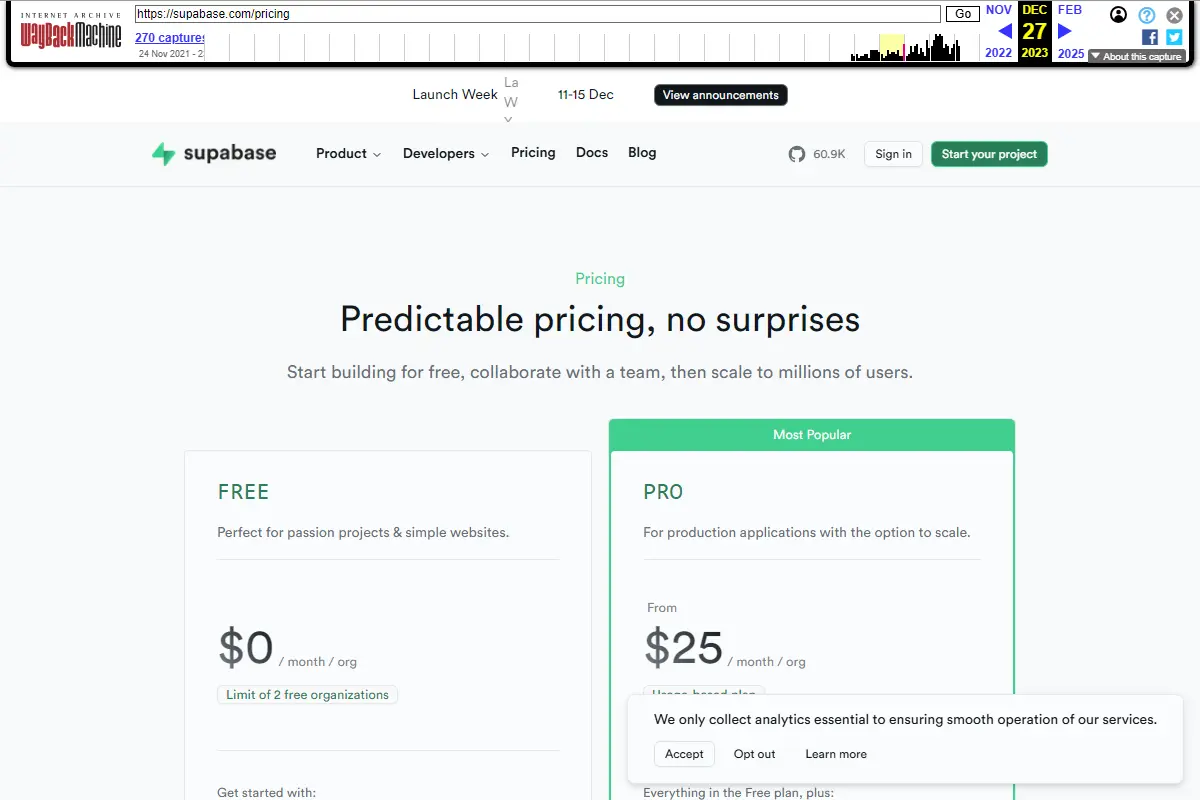
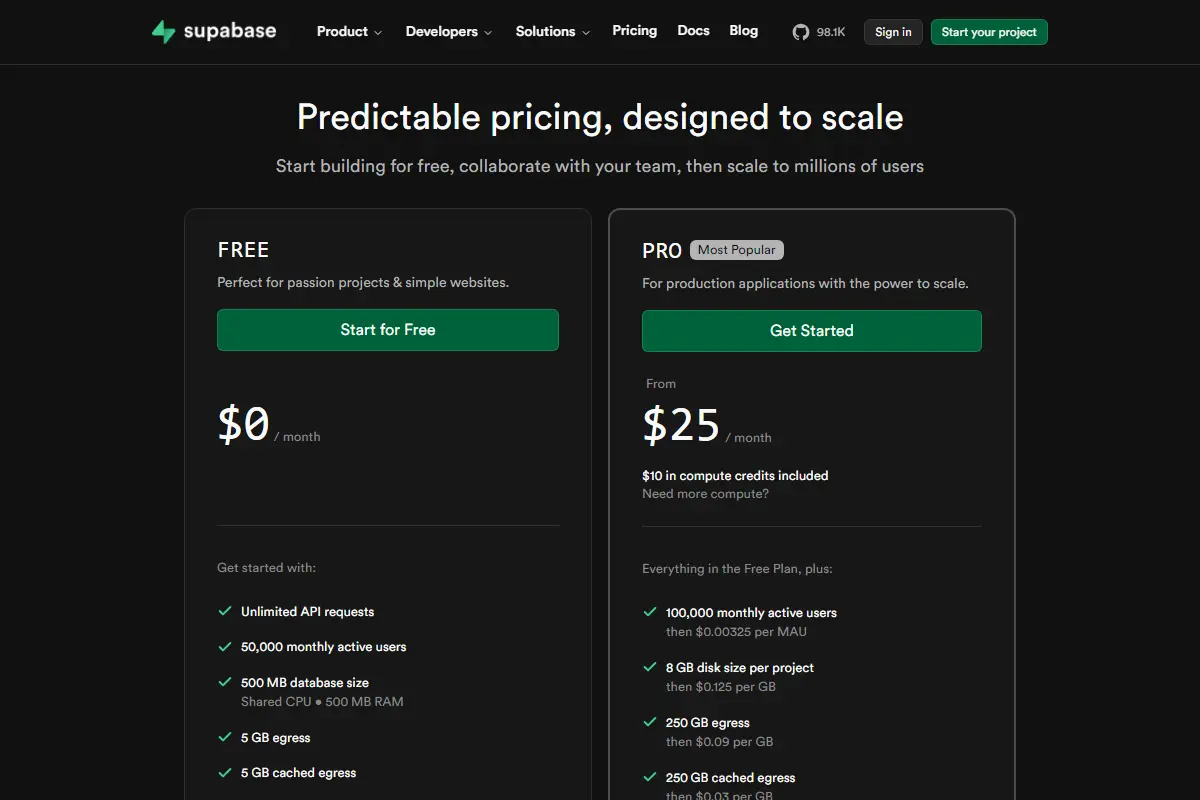
I tracked 5 pricing snapshots from our monitoring system plus public announcements and Archive.org data to piece together exactly what happened with Supabase pricing since launch, what changed in the 2023 billing restructure, and why the $25 price point appears to be permanent.
5 years of Supabase pricing at a glance
| Period | Pro Price | Billing Model | Key Event |
|---|---|---|---|
| 2020 | Free | Alpha | Launch as open-source Firebase alternative |
| Mar 2021 | $25/mo | Per-project | Beta pricing launch (Free + Pro + Usage-Based) |
| Apr 2022 | $25/mo | Per-project | General Availability — pricing unchanged |
| Sep 2023 | $25/mo | Per-org | Organization billing + Team tier ($599) added |
| Feb 2026 | $25/mo | Per-org | $70M ARR, $5B valuation, still $25 |
The pattern is clear: Supabase changes how you're billed, not how much. The $25 Pro price has survived a GA launch, a billing restructure, three funding rounds, and 600% revenue growth.
Supabase pricing timeline (interactive chart)
Data from SaaS Price Pulse monitoring system. Chart shows pricing snapshots captured since we started tracking Supabase.
Phase 1: The open-source Firebase alternative (2020)
Supabase started in January 2020 as an open-source alternative to Google Firebase, built on top of PostgreSQL. Co-founders Paul Copplestone and Ant Wilson launched it during Y Combinator's W20 batch.
During 2020, Supabase was free for everyone. The alpha focused on core features: a hosted PostgreSQL database, authentication, auto-generated APIs, and realtime subscriptions. The pricing model hadn't been defined yet — the team was focused on product-market fit and open-source community growth.
By late 2020, Supabase had raised a $6M seed round led by Coatue. The open-source approach was already paying off: developers could self-host for free or use the managed platform. This dual model — open-source core with managed hosting — became the foundation of their pricing strategy.
Phase 2: Beta pricing launch — $25/month is born (March 2021)
In March 2021, Supabase introduced its first official pricing tiers:
- Free: $0/month — up to 4 active projects, 500MB database, limited resources
- Pro: $25/month per project — 8GB database, higher limits, daily backups
- Usage-Based: Custom pricing for high-scale deployments
The $25 price point was aggressive for 2021. Firebase's Blaze plan (pay-as-you-go) could easily cost $50-100+/month for equivalent usage, and proprietary BaaS platforms like AWS Amplify had complex pricing calculators that made budgeting difficult.
Supabase's pitch was simple: predictable pricing on standard PostgreSQL. No proprietary lock-in, no surprise bills, no calculator needed. $25/month and you know what you're getting.
Six months later (September 2021), Supabase announced their $30M Series A led by Coatue. Total funding: $36M. The $25 Pro price was already proving its worth — developer adoption was accelerating fast.
Phase 3: General Availability — the price that didn't change (April 2022)
When Supabase launched GA in April 2022, the developer community expected a pricing bump. GA launches are a common trigger for SaaS price increases — the product is "real" now, so the price goes up. Notion did it. Figma did it. Most SaaS companies do it.
Supabase didn't.
The Pro plan stayed at $25/month. The Free tier kept the same limits. The only changes were feature additions — not price additions. Supabase used the GA launch to announce new capabilities (Edge Functions, Storage CDN, Vault for secrets management) while keeping the price unchanged.
Behind the scenes, the company had raised a $80M Series B in May 2022 (led by Felicis Ventures). Total funding was now $116M. With that much runway, there was no pressure to raise prices.
What other companies did in 2022
For context, here's what happened to competitor pricing around the same time:
- Heroku — Eliminated the free tier entirely (November 2022)
- Firebase — Kept pay-as-you-go but costs continued rising with usage
- PlanetScale — Would later remove their free tier entirely (announced March 2024, effective April 2024)
- Render — Free tier becoming more restrictive over time
While competitors were tightening free tiers and raising prices, Supabase held firm. This became part of the brand identity: the developer platform that doesn't nickel-and-dime you.
Phase 4: Organization-based billing — the smart restructure (September 2023)
The biggest pricing change in Supabase history came in September 2023, but it wasn't a price increase. It was a billing model restructure that actually reduced costs for many users.
What changed
| Aspect | Before (Per-Project) | After (Per-Organization) |
|---|---|---|
| Billing unit | Each project = $25/mo | First project = $25/mo, additional = $10/mo |
| 3 projects cost | $75/mo | $45/mo (40% savings) |
| 5 projects cost | $125/mo | $65/mo (48% savings) |
| Compute billing | Monthly prepay | Hourly (pay for what you use) |
| Free tier egress | 4GB | 5GB (+25%) |
New tiers added
Along with the billing change, Supabase formalized two additional tiers:
- Team: $599/month — SOC2 compliance, priority support, team management features, SAML SSO
- Enterprise: Custom pricing — HIPAA compliance, dedicated infrastructure, 24/7 SLA, bring-your-own-cloud option
The Pro plan? Still $25/month.
This restructure was smart for two reasons. First, it rewarded power users who run multiple projects — exactly the developers most likely to become paying customers and advocates. Second, hourly compute billing meant users weren't overpaying for resources they only needed part-time.
Phase 5: $70M ARR and the price hasn't moved (2024-2026)
The funding kept coming — and the price kept not changing:
- September 2024: $80M Series C (Craft Ventures)
- Mid-2025: $200M Series D at $2B valuation
- October 2025: $100M Series E at $5B valuation
Total funding: approximately $496M. By August 2025, the company hit $70M ARR — growing 250% year-over-year (up from ~$30M at end of 2024 and ~$17M in mid-2024).
The numbers that define Supabase in 2026:
- 4M+ developers on the platform
- 3.5M+ databases managed
- 2,500+ new databases created daily
- $5B valuation (October 2025, Series E)
- $70M ARR (August 2025, 250% YoY growth)
Current pricing breakdown (February 2026)
| Feature | Free ($0) | Pro ($25/mo) | Team ($599/mo) |
|---|---|---|---|
| Database | 500MB | 8GB | 8GB+ |
| File Storage | 1GB | 100GB | 100GB+ |
| Egress | 5GB | 250GB | 250GB+ |
| MAU (Auth) | 50,000 | 100,000 | 100,000+ |
| Edge Functions | 500K invocations | 2M invocations | 2M+ |
| Backups | None | Daily (7-day retention) | Daily + PITR |
| Support | Community | Priority + SLA |
What's notable is the generous overage pricing. If you exceed Pro limits, the rates are reasonable: $0.125/GB for extra database storage, $0.021/GB for file storage, $0.09/GB for egress, and $0.00325 per additional MAU. No surprise cliffs.

Why the $25 price point works (and probably won't change)
1. Open-source reduces costs
Supabase's core stack is open-source: PostgreSQL, PostgREST, GoTrue, Realtime, Storage. Community contributions reduce engineering costs. The company doesn't need to charge premium prices to fund proprietary development.
2. Usage-based overages drive real revenue
The $25 base price is a floor, not a ceiling. As projects scale, overage charges for storage, egress, and MAU add up. A typical production app on Supabase Pro might cost $35-75/month — well above the $25 base. High-scale customers on Team and Enterprise tiers pay significantly more.
3. Volume beats margins
With 4M+ developers and 2,500 new databases daily, Supabase prioritizes adoption over per-user revenue. A low price point removes the "should I try this?" friction. Once developers build on Supabase, switching costs keep them there.
4. The AI coding tailwind
Supabase's 250% revenue growth in 2025 was partly driven by AI coding tools like Bolt.new and Lovable that generate Supabase-connected apps by default. These tools create new Supabase projects automatically, expanding the user base without traditional marketing spend. The $25 price point makes this frictionless.
Supabase vs competitors: 2026 pricing comparison
| Platform | Entry Price | Free Tier | Pricing Model | Lock-in Risk |
|---|---|---|---|---|
| Supabase | $25/mo | Yes (500MB DB) | Base + usage | Low (PostgreSQL) |
| Firebase | Pay-as-you-go | Yes (limited) | Pure usage-based | High (proprietary) |
| PlanetScale | $39/mo | Removed (2024) | Base + usage | Medium (MySQL) |
| Neon | $19/mo | Yes (512MB) | Base + compute | Low (PostgreSQL) |
| Railway | $5/mo + usage | Trial credits | Usage-based | Low (standard DBs) |
| AWS Amplify | Pay-as-you-go | Free tier (12mo) | Pure usage-based | High (AWS ecosystem) |
Supabase's positioning is unique: it's the only platform that combines a predictable base price with a full BaaS stack (database + auth + storage + realtime + edge functions) on open-source PostgreSQL. Firebase offers a similar feature set but with unpredictable costs. Neon is cheaper but only provides the database layer.
Where this data comes from
This analysis combines data from multiple sources:
- SaaS Price Pulse monitoring: 5 pricing snapshots captured from supabase.com/pricing since we started tracking
- Archive.org Wayback Machine: Historical snapshots of the Supabase pricing page (2021-2025)
- Supabase official blog: Beta pricing announcement (March 2021), Organization billing announcement (August 2023)
- Public financial data: Funding round announcements via TechCrunch, revenue data via Sacra Research and Latka
Confidence level: High for 2023-2026 pricing data (directly verified from official sources and our monitoring). Medium for 2020-2022 data (based on blog announcements and third-party reports, as early pricing page snapshots are limited).
The short version
Supabase is one of the few SaaS companies I've tracked where the pricing story is boring in the best possible way. $25/month in 2021. $25/month in 2026. No dramatic increases, no controversial tier removals, no "new pricing effective immediately" emails.
The only real change — the September 2023 billing restructure — actually made things cheaper for multi-project users. That's the opposite of what most SaaS companies do at the $70M ARR stage.
Whether this holds as Supabase scales toward IPO is an open question. But with ~$496M in funding, open-source economics, and a usage-based revenue model that grows with customers, I'd bet the $25 price point has years of life left in it.
Want to track Supabase pricing changes automatically? View our Supabase pricing tracker for real-time monitoring and historical data.
Share this article
Start Tracking SaaS Pricing Today
Never miss a competitor pricing change. Get instant alerts and stay ahead.
Start Tracking Free →