
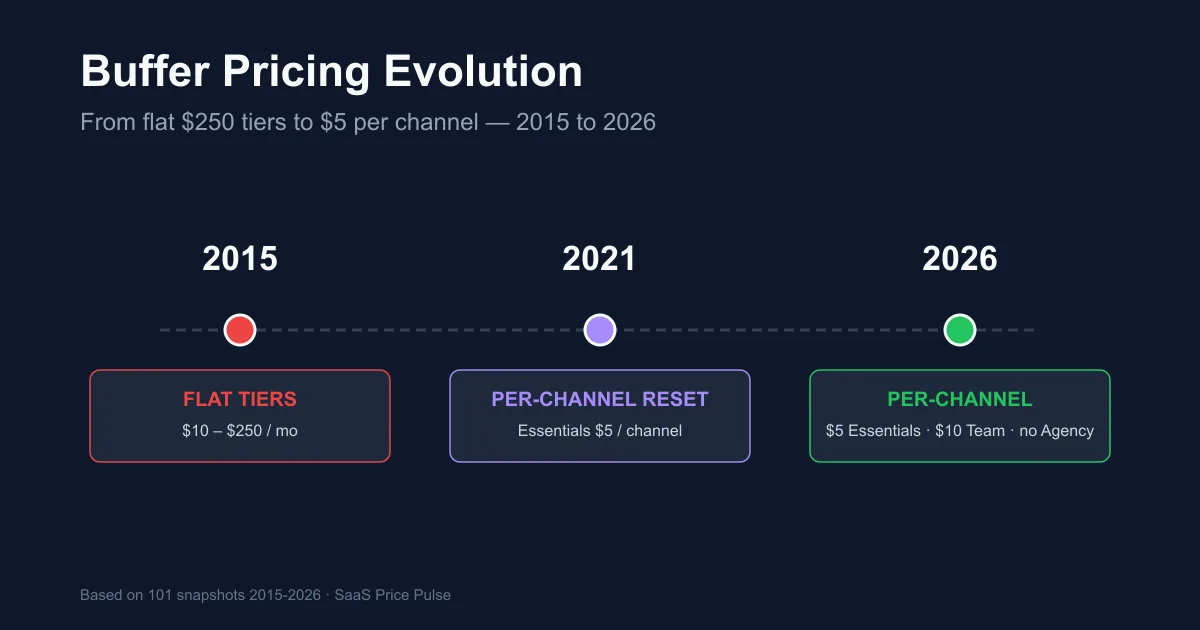
Buffer Pricing History: From $250 Tiers to $5/Channel
Buffer went from flat $10-$250/mo tiers in 2015 to per-channel pricing by 2026 — Essentials $5, Team $10. Full 10-year history, plus why the Agency plan ended.
Buffer Pricing History: From $250 Tiers to $5 Per Channel
Prices verified: June 8, 2026 | Source: buffer.com/pricing | Data: 101 snapshots tracked from 2015 to 2026
Few social media tools have rewritten their pricing as completely as Buffer. It started with fixed monthly tiers, swung to a per-channel model, and recently dropped a whole plan. Here is the full picture, with the receipts.
What Does Buffer Cost in 2026?
Buffer charges per connected social channel. Here is the current lineup, verified June 2026:
| Plan | Price (annual) | Price (monthly) | Best For |
|---|---|---|---|
| Free | $0 | $0 | 3 channels, 10 scheduled posts each, 1 user |
| Essentials | $5/channel/mo | $6/channel/mo | Solo creators — unlimited scheduling + analytics |
| Team | $10/channel/mo | $12/channel/mo | Teams & agencies — approvals, unlimited members |
The key word is per channel. A "channel" is a single connected social profile (one Instagram account, one LinkedIn page, and so on). Pricing scales with how many you connect — which is cheap for an individual but adds up fast for anyone managing many accounts. Above 10 channels, the per-channel rate drops to roughly $3.33, so larger setups get a built-in volume discount. This is a completely different shape from Buffer's original pricing, where you paid one flat fee for a fixed bundle of accounts. We will trace exactly how it got here.
The Big Shift: Flat Tiers to Per-Channel (2021)
For its first several years, Buffer sold the way most SaaS did: fixed monthly plans with feature ceilings. In 2015 you chose between Awesome ($10), Small ($50), Medium ($100), or Large ($250) — each bundling a set number of accounts and posts. The more you needed, the higher the flat tier.
In 2021 Buffer threw that model out. It replaced the entire tier ladder with a simple per-channel structure: a free plan, Essentials at $5 per channel, and a Team add-on. For an individual managing a couple of profiles, this was effectively a price cut — entry pricing fell from a $10-$15 monthly minimum to $5 per channel. For heavy multi-account users, it could cost more, because every profile now carried its own fee.
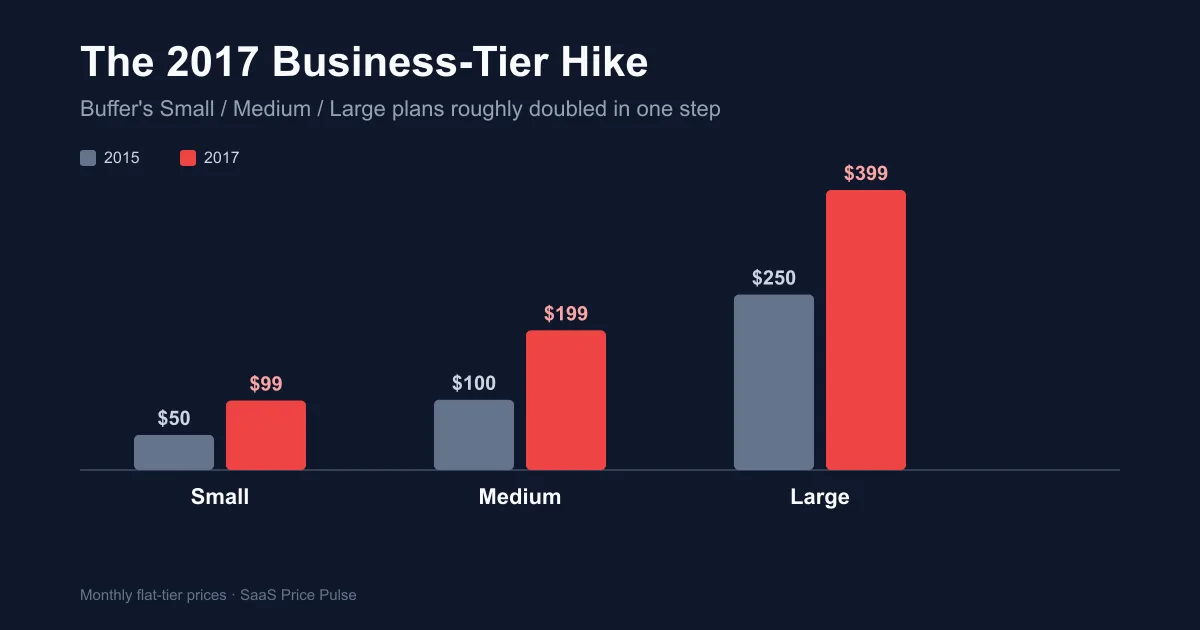
The 2017 Business-Tier Hike
Before the reset, Buffer's business tiers saw a sharp increase. Our snapshots show that between 2016 and 2017 the Small plan jumped from $50 to $99, Medium from $100 to $199, and Large from $250 to $399 — roughly doubling the cost of the mid and upper tiers in a single step. The entry "Awesome" plan held at $10 through this period before being renamed "Pro" and raised to $15 in 2019.
That 2017 hike is part of why the 2021 reset landed the way it did: Buffer had drifted toward expensive, feature-gated business plans, and the per-channel model reset expectations back toward affordability for the solo users who made up much of its base.
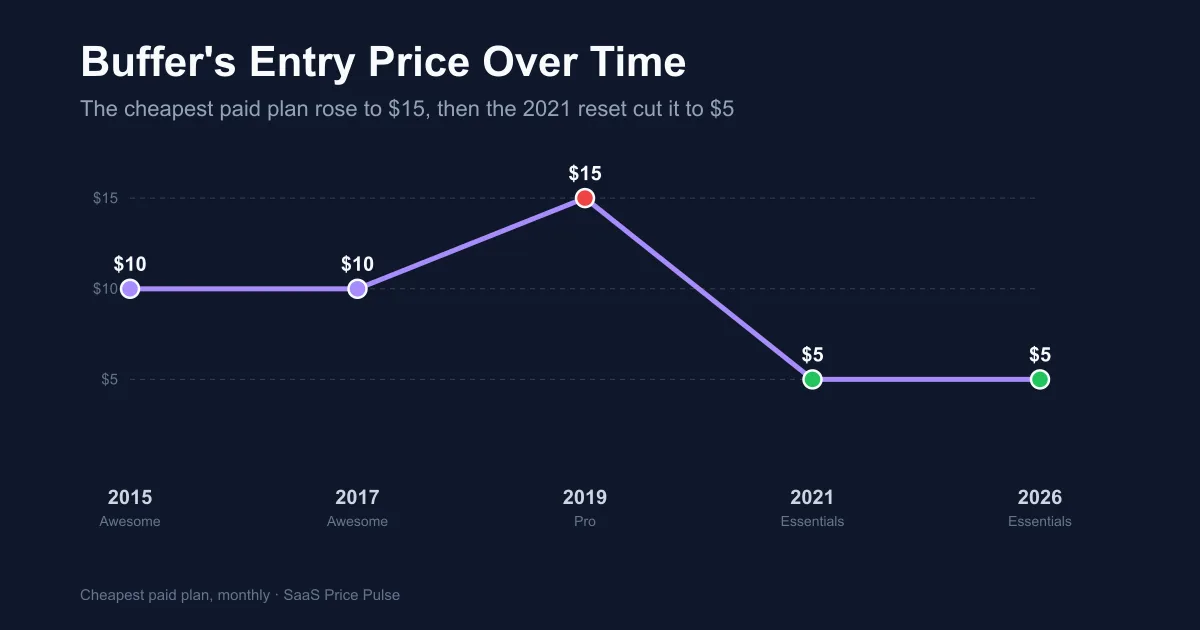
Buffer Pricing Timeline (2015-2026)
| Year | Model | Key Prices |
|---|---|---|
| 2015 | Flat tiers | Free, Awesome $10, Small $50, Medium $100, Large $250 |
| 2017 | Flat tiers (hiked) | Small $99, Medium $199, Large $399 |
| 2019 | Flat tiers | Pro $15 (was Awesome $10), business $99-$399 |
| 2021 | Per-channel (reset) | Free, Essentials $5, Team add-on $12 |
| 2023 | Per-channel | Essentials $5, Team $10, Agency $100 |
| 2024 | Per-channel | Essentials $6, Team $12, Agency $120 |
| 2026 | Per-channel | Free (3 ch), Essentials $5, Team $10 — Agency removed |
Two patterns stand out across the decade. First, the early years drifted upward, with business tiers doubling in 2017. Second, every change since 2021 has been a simplification — fewer plans, priced by channel. Buffer has not chased the steady annual price creep we see across most of the tools we track. Instead it has reset its model twice, both times toward something simpler.
The Agency Plan Is Gone (December 2025)
The most recent change is a structural one. In December 2025 Buffer eliminated its dedicated Agency tier and folded those features into Team. Agencies that once paid for a separate ~$100-$120/month Agency plan now use Team at $10/channel/month instead. Above 10 channels, the per-channel rate falls to about $3.33, so volume discounts replace the old distinct plan.
The move fits a clear pattern. Buffer keeps cutting plans rather than adding them — Awesome became Pro, then the whole tier ladder became per-channel, and now Agency is gone too. For most agencies the change is cost-neutral or slightly cheaper at scale, but it does remove a plan some teams had standardized on. If you were on Agency, your workflows move to Team with no feature loss.
What Per-Channel Pricing Actually Costs
Because Buffer bills per channel, the headline "$5" can be misleading at scale. Here is the real monthly cost on annual billing as channel count grows:
| Channels | Essentials | Team |
|---|---|---|
| 1 | $5/mo | $10/mo |
| 5 | $25/mo | $50/mo |
| 10 | $50/mo | $100/mo |
| 20 (with 11-25 at ~$3.33) | ~$83/mo | ~$133/mo |
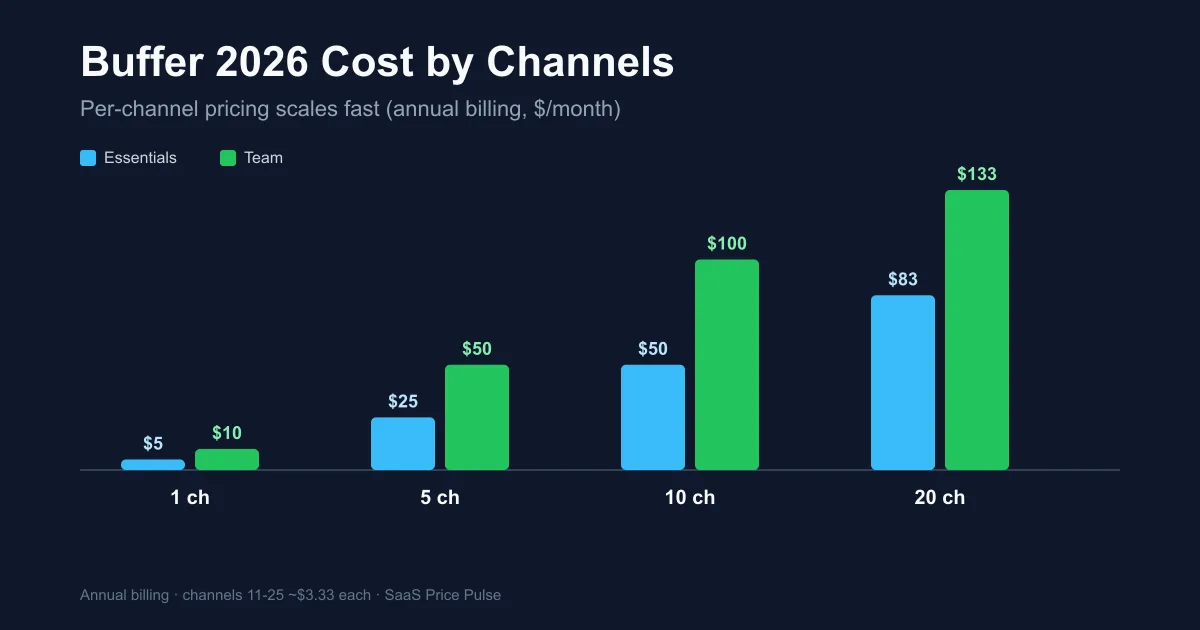
For a solo creator with two or three profiles, Buffer is genuinely cheap — often free. For an agency juggling dozens of client channels, the per-channel model can rival or exceed the old flat business tiers it replaced. Whether the 2021 reset saved you money depends entirely on how many channels you run.
Is Buffer's Free Plan Worth It?
Buffer's free plan has survived every pricing era since 2015. In 2026 it covers 3 channels with 10 scheduled posts per channel and a single user. That is enough for a solo creator or a small brand testing the waters. The two real limits are the post buffer — 10 queued per channel at a time — and the 3-channel cap.
Cross either limit and Essentials at $5/channel is the next step. What stands out historically is the staying power: many rivals have trimmed or removed their free tiers over the years, while Buffer's has held steady through three different pricing models. For a tool that has restructured this much, the free plan is the one constant.
How We Track Buffer's Price
Every figure here comes from automated monitoring of Buffer's pricing page — 101 snapshots spanning 2015 to 2026 — not memory. That history is how we can pin down the exact moment the flat-tier model gave way to per-channel pricing, and how the business tiers doubled in 2017. Vendors rarely advertise their old prices, and pages get rewritten with every change, so this kind of timeline is hard to reconstruct after the fact. Capturing it as it happens is the whole point. We track hundreds of tools the same way, which is how you can compare who raised prices, who restructured, and who held steady — with receipts rather than recollection.
- Compare with another social tool's saga: Hootsuite pricing history.
- See Buffer head-to-head: Social media management pricing comparison 2026.
- A design tool that went the subscription route: Canva pricing history.
- Track every move across SaaS in our live pricing changes feed.
Share this article
Start Tracking SaaS Pricing Today
Never miss a competitor pricing change. Get instant alerts and stay ahead.
Start Tracking Free →