

Amazon SES Free Tier 2026: Is It Still 62,000 Emails?
Amazon SES dropped its 62,000 free emails/month tier in 2023 — now 3,000/month for 12 months, then $200 AWS credits. Free tier + $0.10/1K pricing explained.
Amazon SES Free Tier in 2026: What Happened to the 62,000 Free Emails?
Amazon SES free tier & rates re-verified: June 10, 2026 | Source: aws.amazon.com/ses/pricing
Quick Answer
Amazon SES no longer offers 62,000 free emails per month. AWS cut the free tier to 3,000 emails/month for your first 12 months in August 2023, and accounts created after July 2025 get $200 in AWS credits instead. The core sending rate is unchanged at $0.10 per 1,000 emails — still the cheapest email API, about 5x cheaper than SendGrid at 100K emails/month.
If an older tutorial told you SES gives 62,000 free emails a month from EC2 or Lambda, that deal is gone — AWS removed it in 2023, a 95% cut to the free allowance. This guide covers exactly what the SES free tier looks like in 2026, when and why it changed, and what you actually pay per 1,000 emails afterward, with side-by-side costs vs SendGrid, Postmark, Mailgun, and Brevo. Based on 140+ SES pricing snapshots tracked since 2011.
How Much Does Amazon SES Cost at Every Volume?
SES uses a flat per-email rate with no monthly subscription. The base rate is $0.10 per 1,000 outbound emails regardless of volume. Here is what that looks like in practice:
| Monthly Volume | Per 1,000 Emails | Monthly Cost | Notes |
|---|---|---|---|
| ≤3,000 | $0.00 | Free | First 12 months only (pre-Jul 2025 accounts) |
| 1,000 | $0.10 | $0.10 | Standard rate — no minimum |
| 10,000 | $0.10 | $1.00 | Standard rate |
| 50,000 | $0.10 | $5.00 | Standard rate |
| 100,000 | $0.10 | $10.00 | Standard rate |
| 500,000 | $0.10 | $50.00 | Standard rate |
| 1,000,000 | $0.10 | $100.00 | Standard rate |
Important: The $0.10 rate is flat — there are no volume discounts on the standard shared infrastructure tier. Volume discounts ($0.08, $0.04, $0.02 per 1K) only apply when you use Managed Dedicated IPs, which is a separate add-on. According to AWS documentation, the base sending rate has not changed since SES launched in 2011.
What Hidden Fees Does Amazon SES Charge?
The $0.10 per 1,000 headline is just the sending fee. In our monitoring of SES pricing since 2011, we have tracked several cost components that AWS lists separately on their pricing page but most comparison guides skip:
| Cost Component | Price | When It Applies |
|---|---|---|
| Sending (base) | $0.10/1K emails | Every outbound email |
| Virtual Deliverability Manager | $0.07/1K emails | Opt-in — deliverability insights dashboard |
| Dedicated IPs (Standard) | $24.95/month per IP | For sender reputation isolation |
| Dedicated IPs (Managed) | $15/month per IP | AWS-managed warm-up and reputation |
| Attachment data transfer | $0.12/GB (1 GB free) | Outgoing attachments over 1 GB/month |
| Incoming email | $0.10/1K emails + $0.09/1K chunks | If you receive emails through SES |
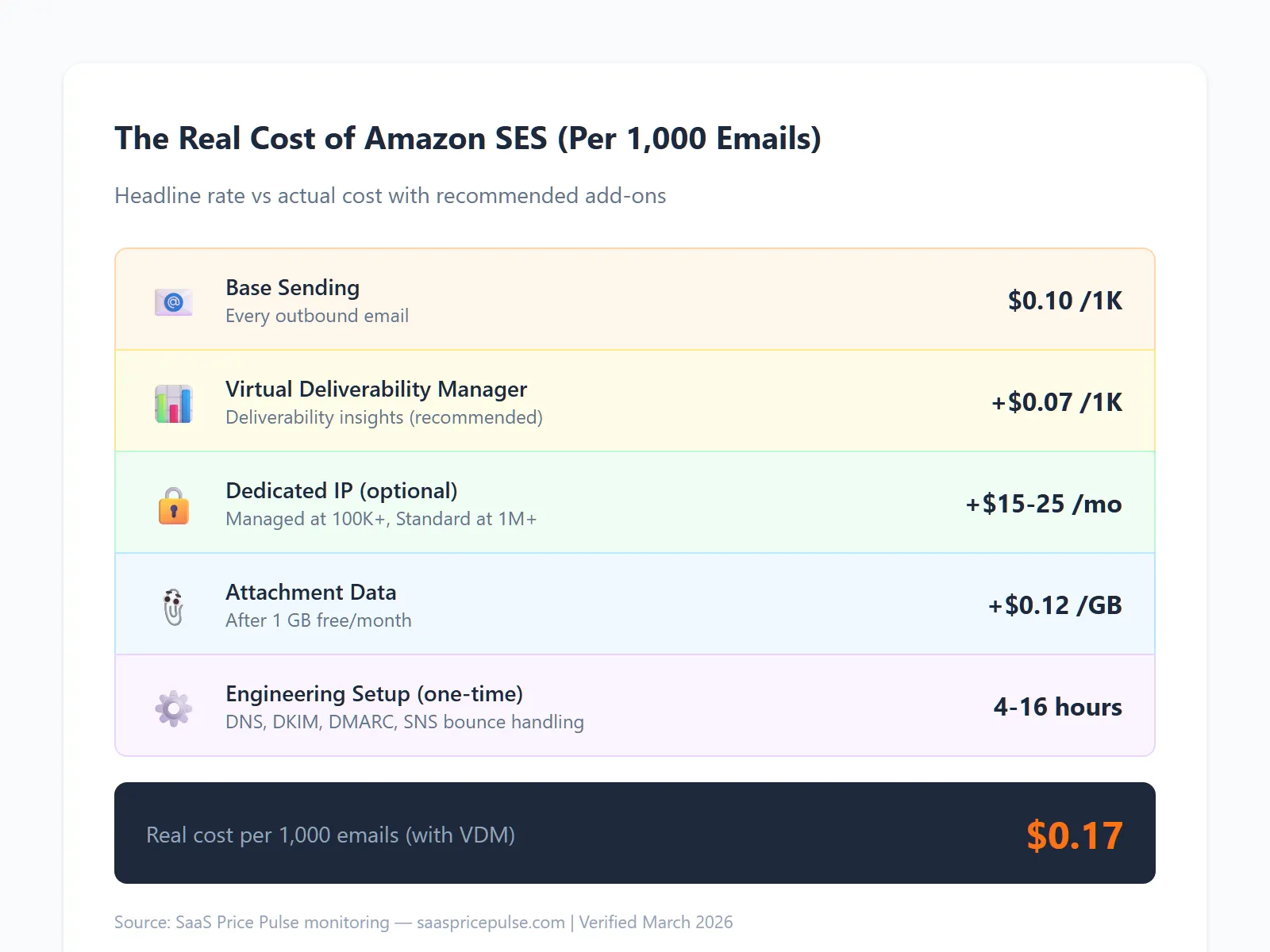
My recommendation: Budget $0.17 per 1,000 emails rather than $0.10. Virtual Deliverability Manager is technically optional, but deliverability monitoring is critical for inbox placement. Without VDM, you are flying blind on bounce rates and complaint metrics.
There is also a hidden setup cost: configuring SES properly (domain verification, DKIM, DMARC, bounce handling via SNS, sandbox exit request) takes 4 to 16 hours of engineering time depending on your AWS experience. That one-time cost does not appear on any pricing page.
What Does Amazon SES Actually Cost at 10K, 100K, and 1M Emails?
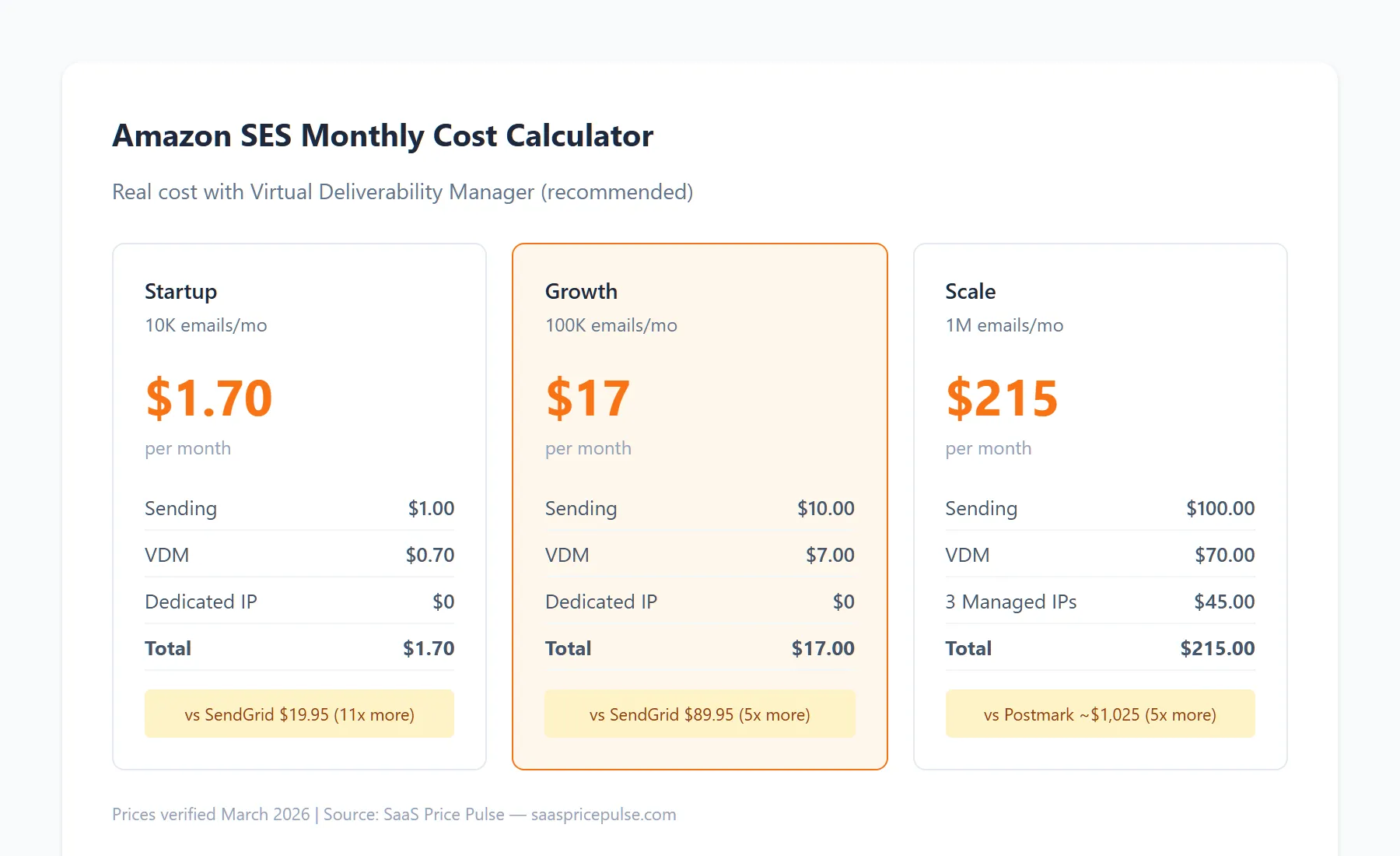
These are realistic monthly bills including Virtual Deliverability Manager. I have separated three volume tiers — startup, growth, and scale — so you can find the one closest to your sending volume and see exactly where every dollar goes. Each breakdown shows the base sending fee, VDM cost, and any dedicated IP charges so there are no surprises on your AWS bill. All prices are based on standard shared infrastructure rates verified against the official AWS SES pricing page in March 2026.
Startup: 10K Emails Per Month
At 10K emails per month, SES is almost free. This volume fits early-stage SaaS apps sending transactional emails like password resets, order confirmations, and welcome sequences. At this scale, shared IPs are perfectly fine because the volume is too low to build meaningful sender reputation on a dedicated IP anyway. Most startups at this tier skip VDM too, though I recommend it even here to catch deliverability issues early before they become hard to fix.
| Sending (10K × $0.10/1K) | $1.00 |
| VDM (10K × $0.07/1K) | $0.70 |
| Shared IPs (default) | $0.00 |
| Total | $1.70/month |
For comparison, SendGrid charges $19.95/month for their Essentials plan which covers up to 50K emails. At 10K emails, you are paying 11x more for SendGrid than SES. But SendGrid includes a drag-and-drop template builder, an analytics dashboard with open and click tracking, and built-in email validation that SES does not offer. If those features matter to your team, the extra $18.25/month might be worth it at this volume.
Growth: 100K Emails Per Month
At 100K emails per month, you are in mid-stage SaaS territory. This is where the cost difference between SES and managed providers becomes substantial. Most companies at this volume are sending a mix of transactional notifications and marketing campaigns. A managed dedicated IP becomes worth considering at this point because shared IP reputation issues can affect your deliverability at scale.
| Sending (100K × $0.10/1K) | $10.00 |
| VDM (100K × $0.07/1K) | $7.00 |
| 1 Managed dedicated IP (optional) | $15.00 |
| Total without IP | $17.00/month |
| Total with IP | $32.00/month |
At this volume, the savings are clear: $17 on SES vs $89.95 on SendGrid Pro, about $130 on Postmark, or $90 on Mailgun Scale. Even with a dedicated IP at $15/month, SES totals $32 — still 3x cheaper than the next-cheapest option. The $73 monthly savings over SendGrid adds up to $876 per year, which is meaningful for growing startups watching their burn rate.
Scale: 1M Emails Per Month
At one million emails per month, you need dedicated IPs for sender reputation isolation. Most senders at this volume run 3 to 5 IPs to distribute sending load and maintain consistent deliverability. AWS recommends warming each IP gradually over 2 to 4 weeks before ramping to full volume. At this scale, standard IPs ($24.95/month) give you more control than managed IPs, especially if you have a deliverability engineer who can fine-tune sending patterns.
| Sending (1M × $0.10/1K) | $100.00 |
| VDM (1M × $0.07/1K) | $70.00 |
| 3 Managed dedicated IPs | $45.00 |
| Total | $215/month |
At 1M emails, SendGrid and Mailgun move to custom pricing, but published estimates range from $400 to $800 per month. Postmark would cost over $1,000 at this volume. The $215 SES bill saves you $200 to $600 per month — enough to fund a part-time deliverability engineer.
Is Amazon SES Cheaper Than SendGrid, Postmark, and Mailgun?
We track pricing for 5 email API providers in our monitoring system. Here is how SES compares at common volumes based on each provider's published pricing pages (verified March 2026):
| Provider | 10K/month | 100K/month | 500K/month | 1M/month |
|---|---|---|---|---|
| Amazon SES | $1.70 | $17 | $85 | $215 |
| SendGrid | $19.95 | $89.95 | Custom | Custom |
| Postmark | $15 | ~$130 | ~$575 | ~$1,025 |
| Mailgun | $35 | $90 | $350 | Custom |
| Brevo | $9 | $45 | Custom | Custom |
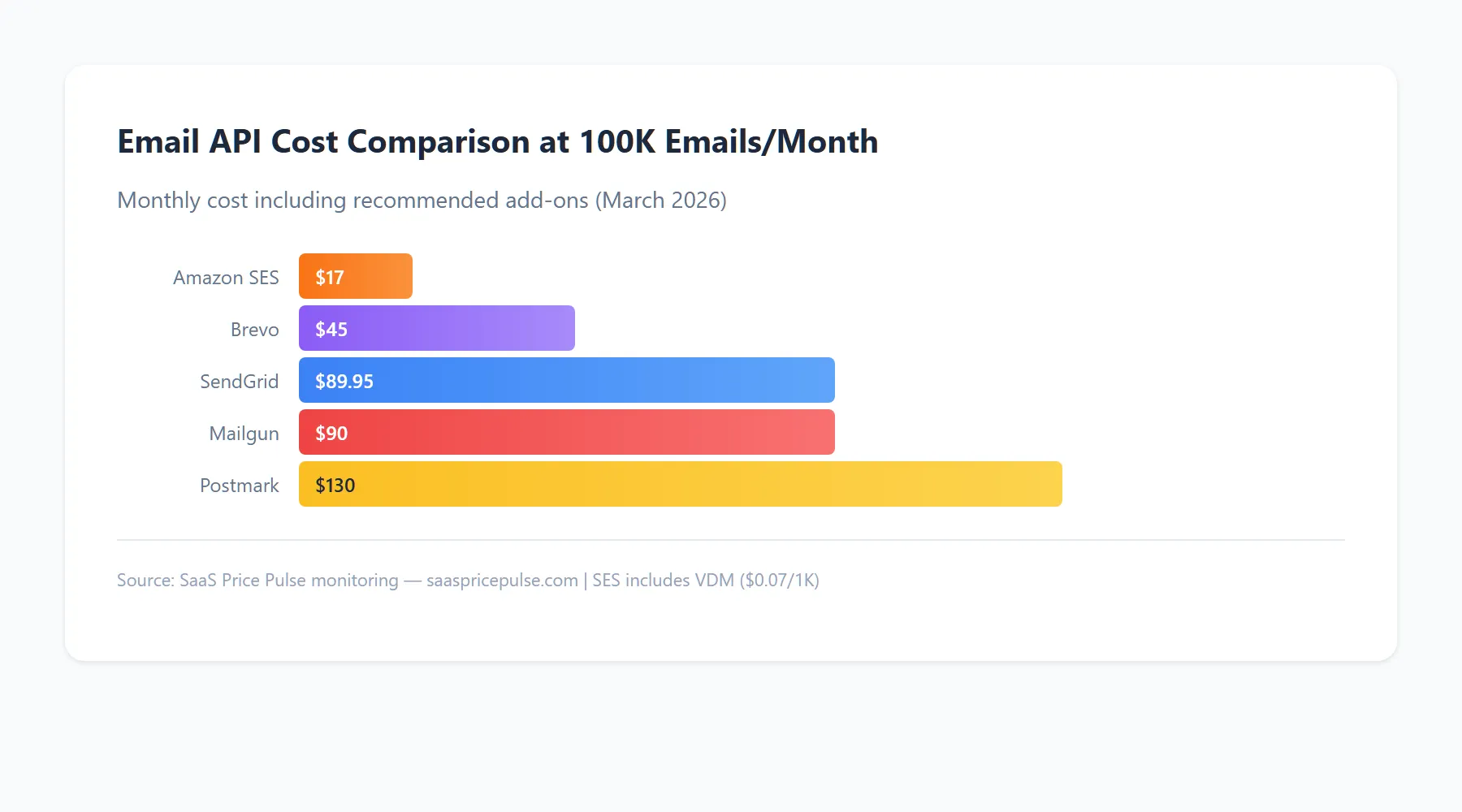
SES is the cheapest at every volume level, typically by 3x to 10x. The trade-off is not price but operational overhead: SES requires AWS expertise (IAM, DNS verification, sandbox exit), while SendGrid and Postmark offer ready-to-use dashboards with template builders and dedicated deliverability support.
When Is SES NOT the Best Choice?
Despite the cost advantage, SES is not right for every team. The following scenarios are where competitors consistently outperform SES on total value, even at higher per-email prices:
- Low volume (<10K/month): Brevo gives 300 emails/day free. SendGrid has a 60-day trial. At $1.70/month, the engineering time to set up SES costs more than the savings.
- Marketing emails with templates: SendGrid and Mailgun include drag-and-drop template builders. SES has API-only template management.
- No AWS experience: The learning curve is real. IAM credentials, SES sandbox, DNS configuration, SNS bounce handling — budget 4 to 16 hours for initial setup.
- Deliverability is everything: Postmark consistently reports higher inbox placement rates for transactional email. If deliverability matters more than cost, Postmark is worth the premium.
What Happened to the Amazon SES 62,000 Free Email Tier?
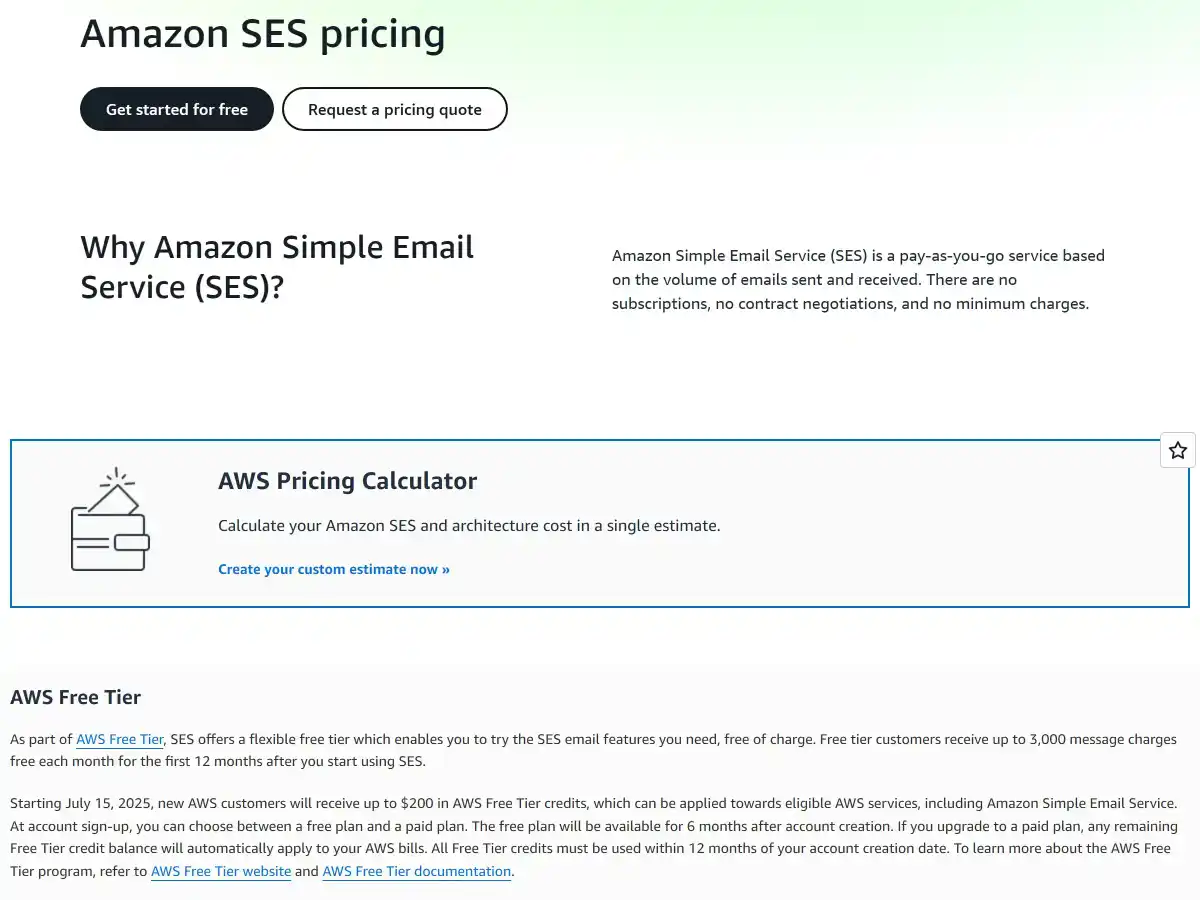
From 2014 to 2023, Amazon SES gave 62,000 free emails per month as long as you sent from an EC2 or Lambda instance. Our archive snapshots show that allowance still live in July 2023 and gone by October 2023 — AWS replaced it with a much smaller, account-age-based tier. The current offer depends on when you created your AWS account. Here is the complete timeline of free tier changes:
| Period | Free Tier | Conditions |
|---|---|---|
| Before Aug 2023 | 62,000 emails/month | Must send from EC2 instance |
| Aug 2023 – Jul 2025 | 3,000 emails/month | Any AWS account, first 12 months only |
| After Jul 2025 | $200 AWS credits | New accounts only; credits apply across all AWS services for 6 months |
The Aug 2023 reduction was a 95% cut. The upside: you no longer needed an EC2 instance to qualify. The downside: 3,000 emails per month is enough for testing, not production. The July 2025 change is more nuanced — $200 in credits covers roughly 2 million SES emails at the $0.10/1K rate, which is generous if you use them before the 6-month expiry.
How Has Amazon SES Pricing Changed Since 2011?
We have monitored Amazon SES pricing across 140+ snapshots over 15 years. The core $0.10/1K rate has never changed, but the free tier, add-ons, and IP options have shifted significantly. Here are the major pricing changes in chronological order:
| Date | Change | Impact |
|---|---|---|
| Jan 2011 | SES launches at $0.10/1K emails | First AWS email service |
| 2014 | Free tier expanded: 62K/month from EC2 | Massive adoption boost |
| 2019 | SES v2 API launched | Better developer experience, pricing unchanged |
| Aug 2023 | Free tier cut: 62K → 3K/month (12 months) | 95% reduction, EC2 requirement removed |
| 2024 | Managed dedicated IPs launched at $15/month | Cheaper alternative to $24.95 standard IPs |
| Jul 2025 | $200 AWS credits replace 3K/month free tier for new accounts | More flexible but time-limited (6 months) |
The remarkable pattern: The base sending rate of $0.10 per 1,000 emails has not changed since SES launched in January 2011. Fifteen years of price stability is almost unheard of in SaaS. AWS adjusts value through free tier changes and add-on pricing rather than touching the core rate. You can see the full pricing history on our Amazon SES pricing tracker.
Should You Add Dedicated IPs?
Shared IPs work fine below 100K emails per month. Beyond that, dedicated IPs give you control over your sender reputation so other senders on the shared pool cannot drag down your inbox placement. AWS offers two options: standard dedicated IPs where you manage everything yourself, and managed dedicated IPs where AWS handles warmup and reputation for you.
| Volume | IP Recommendation | Added Cost | Why |
|---|---|---|---|
| <100K/month | Shared IPs (default) | $0 | Low volume does not justify IP warmup effort |
| 100K–500K/month | 1 Managed IP ($15/mo) | +$15/month | AWS handles warmup and reputation |
| 500K–1M/month | 2–3 Managed IPs | +$30–45/month | Distribute load across IPs for better deliverability |
| 1M+/month | 3–5 Standard IPs ($24.95 each) | +$75–125/month | Full control over PTR records and warmup schedule |
Managed vs Standard: Managed IPs ($15/month) let AWS handle warmup and reputation management automatically. Standard IPs ($24.95/month) give you full control but require manual warmup over 2 to 4 weeks. For most teams, managed IPs are the better choice unless you have a dedicated deliverability engineer.
Managed IPs also include tiered volume discounts on top of the base $0.10/1K rate: $0.08/1K (0–10M), $0.04/1K (10M–50M), and $0.02/1K (50M+). These discounts only apply to the managed IP sending path — not to standard shared infrastructure sending.
Bottom Line: Is Amazon SES Worth It?
After analyzing 140+ pricing snapshots and comparing five email API providers, the answer is clear: Amazon SES is the cheapest email sending service at every volume tier. The $0.10 per 1,000 rate has been stable for 15 years, and the total cost with VDM ($0.17/1K) is still 3x to 10x cheaper than every competitor we track. No other provider comes close on pure cost per email.
The catch: You are paying with complexity. SES requires AWS expertise, manual DNS setup, and active reputation management. For teams already on AWS with engineering bandwidth, the savings are substantial. For everyone else, SendGrid or Postmark offer a better developer experience at 3x to 5x the price.
Decision framework:
- <10K emails/month: Use Brevo or SendGrid free tiers. SES setup time is not worth $1.70/month savings.
- 10K–100K/month on AWS: SES is the clear winner. $1.70 to $17/month vs $20 to $90 on competitors.
- 100K+ without AWS experience: Consider Twilio SendGrid or Mailgun. The learning curve offsets savings.
- 1M+ on AWS: SES saves $200 to $800/month vs competitors. That funds your deliverability investment.
We track Amazon SES pricing alongside 4 other email providers in our Amazon SES pricing tracker. Set up free alerts to get notified if AWS ever changes the core $0.10 rate.
Share this article
Start Tracking SaaS Pricing Today
Never miss a competitor pricing change. Get instant alerts and stay ahead.
Start Tracking Free →